
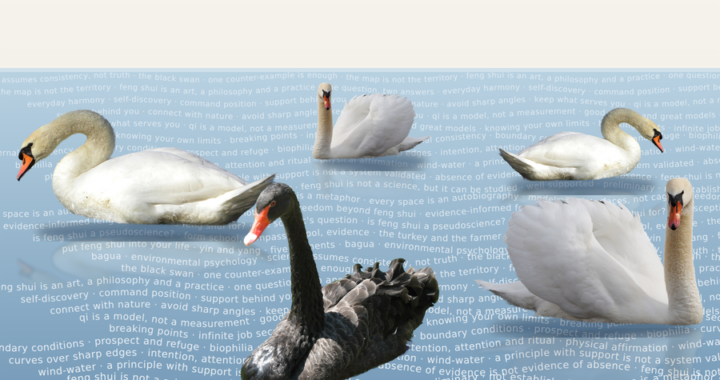
Science Assumes Consistency, Not Truth: What Feng Shui Can Learn from the Philosophy of Science, and What Science Can Learn from Feng Shui

The sceptic’s question
In a culture that prizes double-blind trials, meta-analyses and “evidence-based” everything, feng shui is usually met with the same challenge: Where is the peer-reviewed proof? If it cannot be measured in a laboratory, how can you say it works?

It is a fair question, and after more than forty-five years of practice and several years of doctoral research into feng shui, I want to answer it properly rather than defensively. The answer has two halves. The first half is that feng shui is not a modern empirical science, has never claimed to be one, and does not need to become one in order to be useful. It is an art, a philosophy and a practice (if you want the short version, see What is feng shui? What is feng shui for? Short answers). The second half is that this does not place feng shui beyond examination. A claim can be traditional and still be testable; the only question is what to measure.

Is feng shui a pseudoscience? Only when it pretends to be a science
This is also the right place to deal with the word “pseudoscience”, because it is thrown at feng shui more often than it is earned. The philosopher of science Michael R. Matthews devoted a whole book, Feng Shui: Teaching About Science and Pseudoscience, to using feng shui as a classroom example of how to tell science from its imitations, and his charge sheet is worth reading: an aversion to empirical testing, no attempt to disentangle variables, immunising explanations whenever evidence disconfirms a claim, conflicting advice between practitioners, and the borrowing of scientific words such as “energy” and “magnetic” without their scientific meanings. I summarised the book on this site when it came out (Summary of Feng Shui: Teaching About Science and Pseudoscience by Michael R. Matthews) and I recommend it to every practitioner. But notice what the charge actually is. Pseudoscience is not a property of a tradition; it is a property of a claim. Something becomes pseudoscience at the moment it dresses itself in the authority of science without doing the work of science. Feng shui as an art and a philosophy makes no such claim, and it needs none: nobody accuses painting, ethics or architecture of being pseudoscience, because none of them pretends to be physics. The “scientific feng shui” that Matthews rightly takes apart is the invention of people who understand neither science nor feng shui, and who imagine that a tradition is only respectable if it can be relabelled as a laboratory result. The sensible position, and the one I hold, is the opposite: feng shui is an art, a philosophy and a practice; some of its principles can be studied scientifically and should be; and the moment a practitioner says “science proves” where the evidence does not, they have stopped doing feng shui and started doing pseudoscience.

Continue reading →

Spiritual Feng Shui Talk on Saturday, the 10th of July in London, UK

Spiritual Feng Shui at the Feng Shui Society’s conference on Saturday, the 10th of July in London, UK

As you probably know Feng shui works on many levels, from physical to emotional to mental and to spiritual. Spiritual feng shui deals with the spiritual and transpersonal environmental aspects of individuals or organisations.

In classical and modern feng shui, humans are placed between heaven (spiritual/transpersonal/virtual) and earth (material) dimensions as part of the trinity of luck: heaven’s luck (spiritual), human luck (your skills, mindsets, beliefs, etc.) and earth luck (feng shui). Initially, when feng shui was conceived, it was considered as a spiritual discipline because it was used for sitting for burial places, so the ancestors’ spirits could rest in peace. Modern feng shui aligns itself with modern spirituality and transpersonal psychology in a holistic understanding of the interaction between environments and individuals.

Researchers such as (Koenig, 2012) suggests that when people have organised their homes or workspaces with spiritual understanding and connection, they feel better, are happier and healthier. Some of the research refers to creating sacred spaces for peace, harmony and wellness. In May 1984, the Thirty-Seven World Health Assembly adopted resolution WHA37.13, which made the ‘spiritual dimension’ part and parcel of WHO Member States’ strategies for health.

Spiritual feng shui is here to help you connect with spiritual and transpersonal dimensions and realms and anchor them in your home or workplace. The function of spiritual feng shui is to remind you to balance your personal needs with your spiritual and transpersonal needs to create more connection, peace of mind as well as care and compassion.

In my talk on Spiritual feng shui I’m going to cover:

  • What is spirituality for?
     Health benefits of spirituality – there are over 3300 papers on the benefits of spirituality (people feel better, are happier and healthier when they take care of their spirituality)
  • What is spiritual feng shui for?
     
    Benefits of spiritual feng shui
  • Top practical tips for your spiritual feng shui
     
    How to enlighten your home/workplace
  • What is ultimately spiritual feng shui for? which will help you with your personal feng shui
  • and if there is time, I do have about 100 slides with very comprehensive and evidence-based information – I’ll finish with Q&A

I invite you to book the Feng Shui Conference – the 10th of July, Saturday in London

Looking forward to meeting you and showing you how you can boost you spiritual feng shui and enlighten your home and workplace

Jan Cisek (MSc, FSSA) is a leading international feng shui consultant and expert, trainer, mentor, feng shui researcher and writer with 30+ years experience in feng shui and a background in interior design, design and branding, electromagnetics and geopathics as well as environmental psychology. He specialises in Holistic and Integral Feng Shui which works in many domains: environmental or physical, emotional, intellectual or psychological, social, cultural and virtual or spiritual. Jan is one of the very few feng shui consultants in the world with a Master’s degree in Environmental Psychology thereby combining the scientific rigour of the west to the ancient eastern art of feng shui. Most of his advice is evidence-based so you can trust and have confidence that it will work because it’s based on solid research.

More info on spiritual feng shui

Top tips for spiritual feng shui

Top Feng Shui Tips for Your Academic Success. Top Feng Shui Tips for Students and Passing Exams.

Academic performance is the key to good career prospects and ultimately to wealth creation. Can feng shui principles be applied in boosting academic success? The short answer is, yes. How? Read the top feng shui tips on how to boost academic performance.

1. Personalise your space.
Research suggests that students who personalise their dormitories are happier and perform much better who don’t. In one study, researchers could predict who would drop out from the university by the amount of effort students put into personalising their rooms. Students who took the time to make themselves at home and personalised their rooms were happier and preserved in their studies.
Top tip Display anything that will make your space your own. Put a corkboard and stick anything that has emotional or sentimental value.

Feng shui for universities

Feng shui for academic success

2. Look after your sleep.
The latest research is very clear about the importance of sleep for learning, memory and general wellness. The more you learn the more you have to sleep. Don’t compromise on your sleep – especially, before the exams. Sleep in total darkness to optimise the release of the dopamine, the sleep hormone.

Continue reading →