
The sceptic’s question
In a culture that prizes double-blind trials, meta-analyses and “evidence-based” everything, feng shui is usually met with the same challenge: Where is the peer-reviewed proof? If it cannot be measured in a laboratory, how can you say it works?
It is a fair question, and after more than forty-five years of practice and several years of doctoral research into feng shui, I want to answer it properly rather than defensively. The answer has two halves. The first half is that feng shui is not a modern empirical science, has never claimed to be one, and does not need to become one in order to be useful. It is an art, a philosophy and a practice (if you want the short version, see What is feng shui? What is feng shui for? Short answers). The second half is that this does not place feng shui beyond examination. A claim can be traditional and still be testable; the only question is what to measure.
Is feng shui a pseudoscience? Only when it pretends to be a science
This is also the right place to deal with the word “pseudoscience”, because it is thrown at feng shui more often than it is earned. The philosopher of science Michael R. Matthews devoted a whole book, Feng Shui: Teaching About Science and Pseudoscience, to using feng shui as a classroom example of how to tell science from its imitations, and his charge sheet is worth reading: an aversion to empirical testing, no attempt to disentangle variables, immunising explanations whenever evidence disconfirms a claim, conflicting advice between practitioners, and the borrowing of scientific words such as “energy” and “magnetic” without their scientific meanings. I summarised the book on this site when it came out (Summary of Feng Shui: Teaching About Science and Pseudoscience by Michael R. Matthews) and I recommend it to every practitioner. But notice what the charge actually is. Pseudoscience is not a property of a tradition; it is a property of a claim. Something becomes pseudoscience at the moment it dresses itself in the authority of science without doing the work of science. Feng shui as an art and a philosophy makes no such claim, and it needs none: nobody accuses painting, ethics or architecture of being pseudoscience, because none of them pretends to be physics. The “scientific feng shui” that Matthews rightly takes apart is the invention of people who understand neither science nor feng shui, and who imagine that a tradition is only respectable if it can be relabelled as a laboratory result. The sensible position, and the one I hold, is the opposite: feng shui is an art, a philosophy and a practice; some of its principles can be studied scientifically and should be; and the moment a practitioner says “science proves” where the evidence does not, they have stopped doing feng shui and started doing pseudoscience.
What Donald Hoffman’s critics got wrong
What makes this conversation more interesting than the usual sceptic-versus-believer exchange is that science itself does not work in the way its loudest defenders imagine. When the cognitive scientist Donald Hoffman presented his Interface Theory of Perception, which argues that evolution shaped our senses for survival rather than for seeing reality as it is, critics accused him of sawing off the branch he was sitting on: using an evolutionary theory to undermine the physical world that evolution is supposed to take place in. Hoffman’s reply was a short lesson in the philosophy of science, and it applies with surprising precision to feng shui. Science, he pointed out, does not assume that its starting premises are true. It assumes only that they are internally consistent. Every theory rests on axioms it does not explain, every good theory organises a domain, and a great theory goes one step further and tells you where its own assumptions stop working.
In this article I take five of those principles and hold them up against feng shui. Some of them flatter feng shui; some of them discipline it. Both are useful.
1. The black swan: what a single exception does, and does not, prove
One counter-example is enough
Karl Popper’s insight was that universal claims are fragile in a very specific way. To show that “all swans are white” is false, you do not need ten thousand observations. You need one verified black swan. For centuries Europeans had seen only white swans and treated the whiteness of swans as a settled fact, until black swans were found in Australia. One counter-example was enough to retire a universal rule, and it did something more productive than that: it forced naturalists to look for the deeper framework that explains both the white swans and the black one.
Taleb’s black swan: the improbable event that changes everything
Nassim Nicholas Taleb borrowed the image for his book The Black Swan and gave it a second meaning that is just as relevant here. Taleb’s black swan is an event that lies outside ordinary expectation, carries an extreme impact, and is explained away afterwards as if it had been predictable all along. His targets were financial markets and forecasters who mistake the absence of a black swan so far for proof that black swans do not exist. His deeper argument is about the limits of what we can know from past regularities: the turkey that is fed every day for a thousand days has more evidence than ever that the farmer is benevolent, right up to the day before Thanksgiving. Both meanings of the black swan matter for feng shui. The first tells us that no rule about spaces is safe from a single counter-example. The second warns us that a run of successes is not proof that our model of a space is complete, and that the factors we have not been measuring are often the ones that decide the outcome.
The feng shui black swan
Feng shui is full of universal-sounding rules. A popular manual will tell you that a south-facing door always brings recognition, or that water in a particular sector always brings wealth. Then a practitioner visits a south-facing house whose occupants have struggled for years, and the sceptic says: there is your refutation. The mature practitioner sees something different. This house is a black swan. It disproves the slogan, not the discipline. It sends you back to the fuller analysis: the landform and the approach to the building, the internal layout, the light and the air, the timing, and above all the people who live there. A failed surface rule is an invitation to think, which is exactly what it is in science.
The swan cuts both ways
Here, though, I part company with the argument as it is often made in feng shui’s defence, because the black swan cuts both ways. If one exception can retire a universal rule, then one success story cannot establish one. The client whose insomnia lifted after we moved her bed is real, and she matters enormously; she is the whole point of the work. But she is a case, not a law. Environmental psychology works with populations and averages precisely because individual results are noisy: people differ, houses differ, seasons and life events differ, and expectation alone can move outcomes. Neither perspective is wrong. The practitioner is rightly concerned with this person in this space at this moment; the researcher is rightly concerned with what holds across many people and many spaces. A serious feng shui has room for both, and my own doctoral research is built around that distinction between personal preferences and the more general, transpersonal patterns that seem to hold for most of us.
Do single cases count as evidence?
They do, but as the weakest form of it, and knowing why is more useful than dismissing them. Medicine, which has thought about this longer than anyone, keeps the case report at the bottom of its evidence hierarchy and yet refuses to throw it away: Jan Vandenbroucke’s defence of case reports points out that they are how new effects, unexpected side effects and new mechanisms are first noticed, and Jeffrey Aronson and Manfred Hauben have shown that an anecdote can even be definitive on its own when the effect is large, immediate, reversible and has a clear mechanism, as when a symptom appears each time a drug is taken and vanishes each time it is stopped.
That is the position for feng shui. The client who slept badly for years, moved her bed and slept well the next week is real evidence that something happened, but on its own it cannot say what: the move, the attention she paid to her sleep, the expectation that the change would help, the season, the conversation with a consultant, or the plain tendency of bad patches to improve in time. A single case becomes stronger evidence when it starts to behave like an experiment, which is why medicine developed the n-of-1 trial, in which one person alternates between conditions several times so that chance and expectation have a harder time explaining the result, and why psychology and education have formal standards for single-case designs that require repeated, planned reversals before an effect is credited. A feng shui practitioner can borrow that logic today: record the situation before the change, make one change at a time, ask the client to keep a simple diary, and where practical try the old arrangement again for a week before settling. Done that way, anecdotes stop being stories and become data, and a shelf of them is how the questions for the larger studies are found.
2. Science assumes consistency, not truth
Coordinates are not threads in space
A common assumption is that science deals in objective truth while feng shui deals in unproven notions like the five elements or the bagua. The comparison is unfair to both sides.
No physicist believes that x and y axes run through space like threads, or that a force vector is a physical object. Coordinates, vectors and field equations are an internally consistent language for mapping how physical things behave. Their justification is that the language holds together and that it predicts. Hoffman’s point is that this is true of every scientific theory: the theory does not explain its own axioms, it uses them.
The five elements and the bagua as a language
Feng shui works on the same footing, and it is open about it when it is practised well. Nobody claims that “wood” or “metal” exist as substances on a periodic table. The five elements describe processes: growth, expansion, stability, contraction, stillness. Yin and yang describe rhythm and relationship rather than two kinds of stuff. The bagua is a map of life areas laid over a plan, a diagnostic lens that asks which part of your life is receiving attention and which is neglected. These are symbolic, internally consistent languages for reading a space and for acting in it. The map is not the territory, the menu is not the meal, and the bagua is a model rather than a mechanism. Its value lies in whether it helps you see something you would otherwise have missed and then do something about it.

Even the name of the discipline is a model rather than a description. Feng shui means wind-water, the two forces that carry and shape everything else in a landscape, and not “wind and water” as two separate items on a list; I have written about why that small difference matters in Feng shui means wind-water, not wind and water.
Qi is a model, not a measurement
Qi belongs in the same category, and I would rather say so plainly than dress it up. Qi is the central working concept of feng shui, a way of talking about flow, vitality and the felt quality of a place, and there is no scientific definition of it. That does not make it useless; it makes it a model. A model earns its keep by what it lets you do, and it is retired when a better one comes along.
3. Unexplained foundations and “infinite job security”
Science is an open-ended unfolding
Because no theory explains its own starting assumptions, Hoffman observes, there is always room for a deeper theory to explain the premises of the earlier one. He calls this “infinite job security in principle” for scientists. Science is an open-ended unfolding, not a finished building.
How feng shui has evolved: form, compass, and now evidence
Feng shui has evolved in precisely this way. The earliest form school took the landscape as its unexamined premise: mountains behind a dwelling for shelter and support, water in front, protection to the sides, an open prospect ahead (see Prospect and Refuge Theory,
Appleton, 1975). When people moved from valleys into towns and then into apartment blocks, those premises no longer covered the cases practitioners met, and compass and time-based schools developed to deal with orientation, entrances and cycles inside built structures. Today the environments have shifted again: open-plan offices, screens in every room, homes shared with routers and a great deal of electrical equipment, and work that happens wherever the laptop is. A contemporary, evidence-informed feng shui that draws on environmental psychology, building biology, semiotics and plain common sense is the next layer in the same process, not a betrayal of the tradition.
Is science reactive and feng shui proactive?
Here I want to correct a claim that is often made on feng shui’s behalf, because it is only half true. It is said that science is reactive and feng shui proactive: that feng shui knew about the benefits of nature and of a protected position centuries before researchers “discovered” biophilia and prospect and refuge. There is something in this. Edward Wilson’s biophilia hypothesis and Jay Appleton’s prospect-refuge theory do describe, in modern terms, what the armchair configuration and the feng shui preference for greenery and views were describing in older ones, and it is fair to say that the tradition observed these patterns long before anyone measured them. But the tradition also accumulated claims that have not survived contact with evidence, and a tradition that keeps everything it has ever believed is not proactive; it is merely old. The value of the modern work is that it lets us sort the inheritance: this part is supported, this part is untested, this part is culture-specific formula, this part is superstition (I keep a running list in Feng shui myths, superstitions and false problems). Science does not validate feng shui wholesale and it does not refute it wholesale. It helps us tell the difference, and that is a gift to practitioners rather than a threat.
4. Good models and great models: knowing your own limits
A good rule and a great practice
Hoffman draws a distinction between a good theory and a great one. A good theory gives you tools to organise the phenomena in its domain. A great theory also gives you the tools to discover the exact limits of its own assumptions.
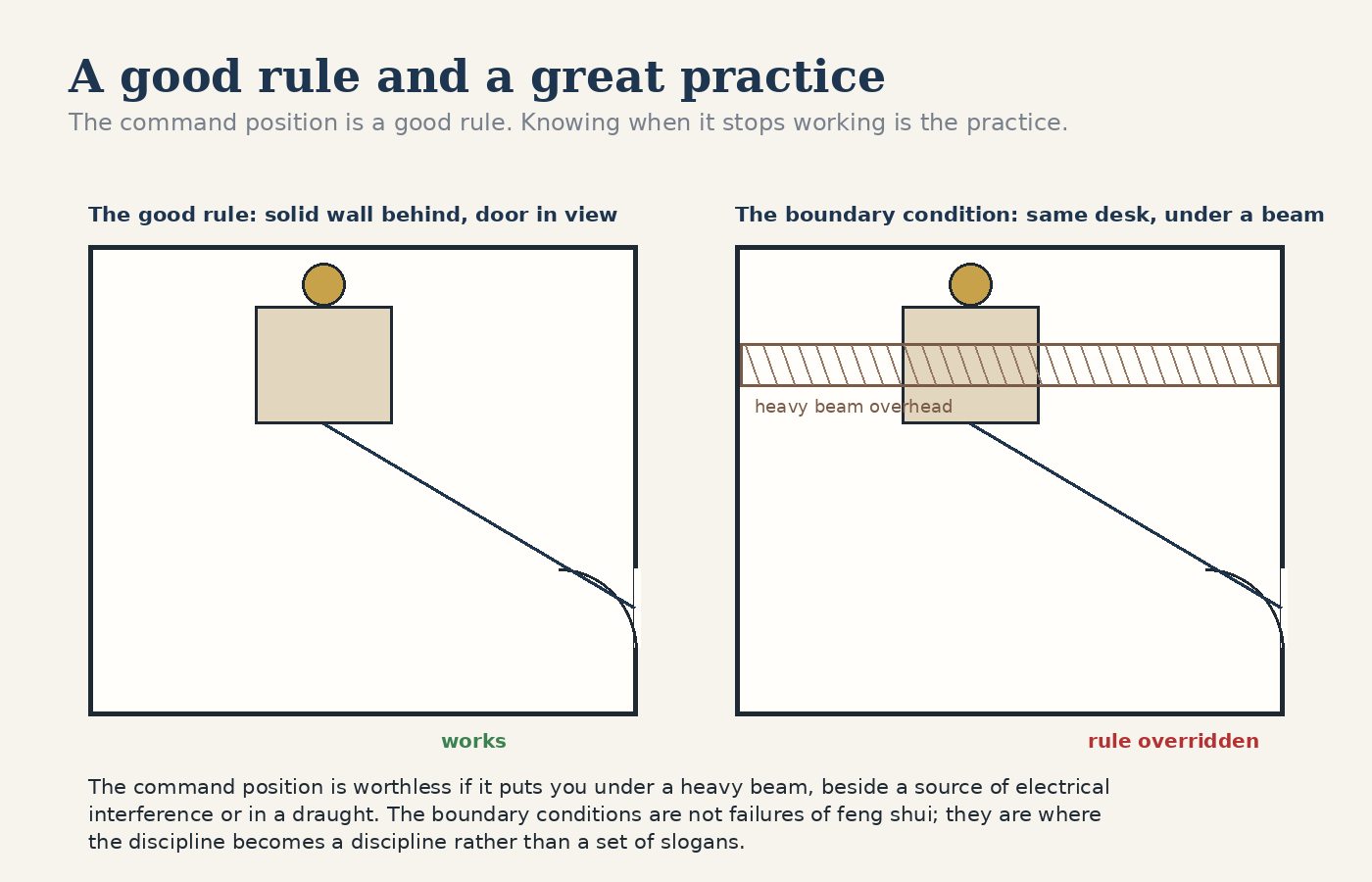
A good feng shui rule gives you a checklist: put the desk so that you can see the door with a solid wall behind you; put the bed in the command position with a proper headboard. These are good rules and I teach them. A great feng shui practice knows when and why such rules stop working. The command position is worthless if it places you under a heavy beam or heavy oppressive features, beside a source of electrical interference, or in a draught from a badly sealed window. A water feature that a formula recommends for one sector may be exactly wrong for a person who finds moving water unsettling, or for a room that already has too much movement in it. An open, welcoming entrance hall that “collects qi” on paper becomes a wind tunnel in practice if the doors align. The boundary conditions are not failures of feng shui; they are where the discipline becomes a discipline rather than a set of slogans.
Five principles that recur across every school
This is why, when I teach, I keep returning to the small set of principles that recur across every school of feng shui I know, and that also happen to be the ones I can test: sit and sleep in the command position; have something solid behind you; bring nature in; avoid sharp angles and oppressive features pointing at you; and keep what serves you while clearing what drains you. Everything else is an elaboration or a special case, and the mark of a good practitioner is knowing which is which.
What feng shui does not do
It is also why I am explicit about what feng shui does not do. It does not guarantee wealth, health or love. It does not replace medical, legal or financial advice. It does not work through fear, superstition or rigid rules. What it does is support the conditions for a good life, direct attention and intention, and grow awareness of how you actually live and work. A model that overclaims is a weak model, in science and in feng shui alike.
5. Breaking points: laboratories, real homes and the Planck scale
Where great theories admit their limits
Hoffman’s final illustration is from physics. General relativity and quantum field theory both assume space and time as their foundation, and both work superbly in their domains. Yet their own mathematics indicates that this foundation ceases to be usable at the Planck scale, the almost unimaginably small lengths and times at which the two theories cannot be reconciled. Far from embarrassing these theories, this is what makes them great: their internal logic reveals where their starting assumption reaches its limit.
The laboratory’s breaking point
Evidence-based research on environments has a breaking point of its own, and it is worth naming. Laboratory studies require control. You isolate one variable, hold the rest constant and measure the difference. That is how we know, with reasonable confidence, that people tend to prefer curved forms over angular ones, that a view of greenery is associated with faster recovery and lower stress, that a room with plants tends to lift mood and attention, and that a disordered desk can be good for creativity as well as bad for a sense of control. Each of these is a real finding, and each was obtained by narrowing the world down to something measurable.
Real homes are not narrow
Real homes and workplaces are not narrow. A bedroom is not isolated from the road outside, the history of the building, the neighbours, the weather, the relationship of the two people who sleep in it or the state of their working lives. A dozen factors interact at once, and this is exactly the territory in which feng shui has always operated. When people say that feng shui “cannot be tested”, what they usually mean is that the whole system cannot be tested in one experiment, which is true of any complex practice, including medicine and architecture.
Testing one principle at a time: my PhD
What can be done is to test the principles one at a time, under controlled conditions, and then to ask how they combine. That is the logic of my own doctoral studies: image surveys of bedroom and workplace designs to establish what people prefer, followed by virtual-reality rooms in which participants’ physiological responses are recorded while they experience feng shui-compatible and incompatible designs. Virtual reality is a compromise. It gives control that a real house never could, at the cost of some realism. But it lets us measure not only what people say but how their bodies respond, and it moves the conversation from opinion to evidence, one principle at a time.
When does a practice become evidence-based?
There is no magic number of studies at which a practice crosses the line, and anyone who gives you one is guessing. What the evidence-based movement in medicine actually asked for, when David Sackett and colleagues defined it in 1996, was not a quantity of research but a habit: making decisions by combining the best available evidence with professional judgement and the preferences of the individual, and being sincere about how good that evidence is. The GRADE system that grew out of it rates a body of evidence high, moderate, low or very low according to how the studies were designed, whether they agree with one another, whether the effect is precise and whether the results could be explained by bias, and a claim rises through those grades mainly by being tested in ways that would have allowed it to fail, by being replicated independently, and by being pulled together in a systematic review that weighs all the studies rather than the flattering ones. Psychology learnt the hard way why this matters: when a large collaboration tried to reproduce a hundred published psychology experiments in 2015, fewer than half replicated, and John Ioannidis had already argued a decade earlier that most published findings in small, flexible, fashionable fields are likely to be false.
So the answer to “how much research is needed” is: enough independent, well-designed studies that a sceptic cannot explain the pattern away, which in practice means several replications from different research groups rather than one impressive result.
Environmental psychology is a useful example of a practice-adjacent field that made that journey. Architects, planners and psychologists had been observing how buildings affect people for decades, but the field became a science between roughly 1968 and 1981 by fulfilling a recognisable set of criteria: it defined its subject matter (the transactions between people and their physical settings) and stopped borrowing its questions from adjacent fields; it produced theories that made testable predictions, such as prospect-refuge, attention restoration and stress recovery; it developed instruments whose reliability could be checked, from environmental preference scales to measures of place attachment and perceived restorativeness; it adopted methods that other researchers could repeat, including field experiments and later physiological measurement; it created the institutional apparatus of a discipline, with its own peer-reviewed journals (Environment and Behavior in 1969 and the Journal of Environmental Psychology in 1981), review chapters in the Annual Review of Psychology from 1973 onwards, and a division of the American Psychological Association; and, crucially, it began to accumulate and audit its own findings, so that by 2010 systematic reviews could ask whether contact with natural environments really does improve health and answer with a qualified yes, and by 2014 Robert Gifford could assess forty years of the field’s achievements and its unresolved problems.
Feng shui is not going to become environmental psychology, nor should it, but the five principles I test are being put through exactly that machinery, one at a time, and the only respectable claim to “evidence-based feng shui” is the one that can say, for each principle, which grade of evidence it currently has.
The future of feng shui is measurable. As virtual reality lets us build the same room in a feng shui-compatible and an incompatible version and swap between them at will, and as psychophysiological measures such as heart rate, electrodermal activity and facial muscle response, together with eye tracking and wearable sensors in real homes, let us record what the body does in those rooms rather than only what people say about them, feng shui will for the first time be able to state its claims in the language of effect sizes and mechanisms, so that a practitioner of the next decade may be able to say not “the command position brings good fortune” but “sitting with a wall behind you and the door in view lowers arousal by roughly this much, for most people, through this pathway, and here is the evidence”, which is a smaller claim than the tradition makes and a far stronger one.
Research on feng shui is already here and accelerating. A title search of the academic literature now returns hundreds of papers with feng shui in the title, spanning architecture, environmental psychology, tourism, business, health and cultural studies, and they come from both directions at once: from universities in China, Taiwan, Hong Kong, Singapore and Korea, where feng shui is being re-examined as part of a living design heritage, and from Europe, North America and Australia, where environmental psychologists and designers are asking why so many of its principles look like their own findings arrived at by another road. And the early results are encouraging. Where feng shui’s core principles have been put to the test, mostly under other names, they have held: people do prefer a protected position with a view of the room, they do respond to curves over sharp edges, contact with nature does lower stress and speed recovery, and the bedroom conditions feng shui has always prescribed are the ones sleep science now recommends. In my own doctoral studies, which place feng shui-compatible and incompatible bedrooms and workplaces in virtual reality and record how people’s bodies respond, the preliminary findings suggest that most people prefer the feng shui-compatible settings, and the psychophysiological data will show whether the body agrees with the vote. This is one of the first attempts to test the principles this way, and I intend it as an opening move, not a last word. The instruments exist, the questions are sharp, and the field is wide open: to every researcher, practitioner and student reading this, the invitation is to take one principle, design a study fair enough that it could fail, and publish what you find, whichever way it goes. Every positive result won that way is worth a hundred testimonials, and every negative one tells us where the tradition needs to grow. The question is no longer whether feng shui can be studied scientifically, but who will do the studies, and how well.
What the evidence currently supports, and what it does not
Because the argument above can be misread as licence to claim anything, let me be concrete about where things stand as I understand them.
Well supported
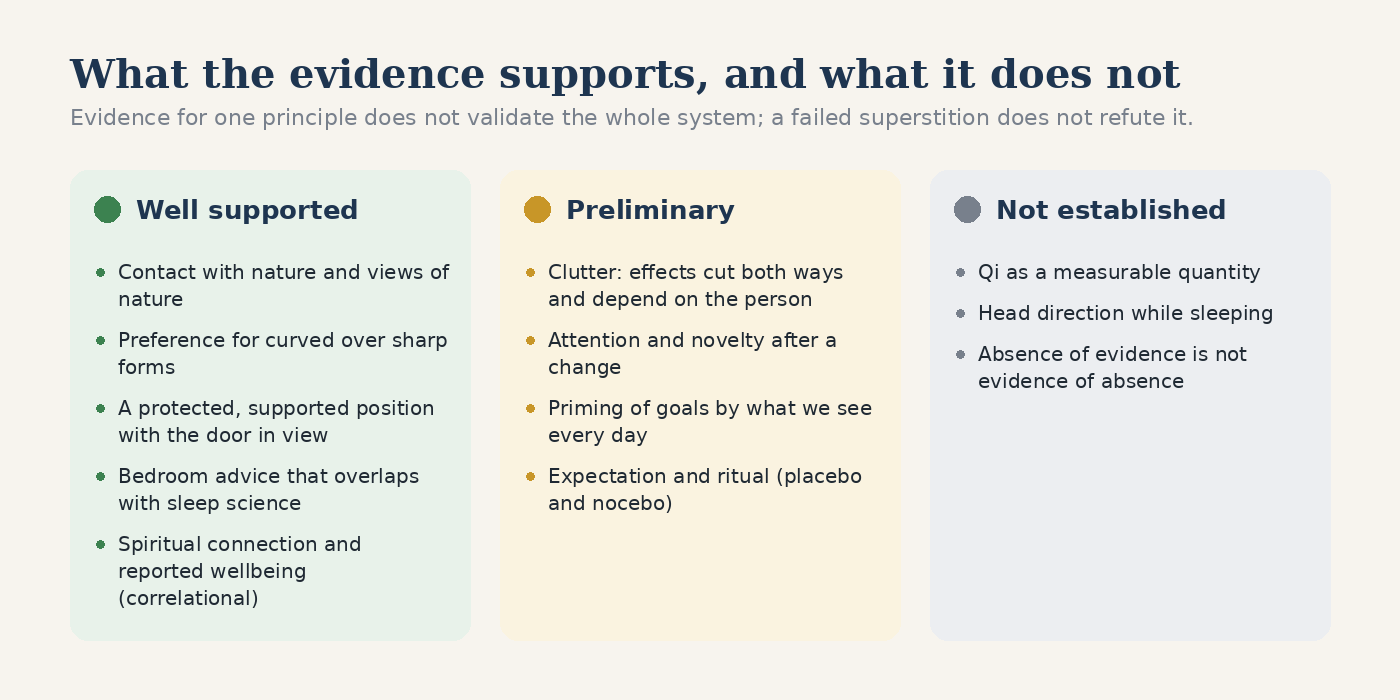
Well supported are the environmental principles that feng shui shares with environmental psychology and ergonomics: contact with nature and views of nature; a preference for curved rather than sharp forms; the psychological value of a protected, supported position with a view of the room and the door; and the overlap between feng shui bedroom advice and what sleep science recommends about darkness, quiet, cool temperature and the absence of screens. Reasonably well supported, though correlational, is the link between a sense of spiritual connection and reported wellbeing, which is relevant because feng shui has always had a spiritual dimension.
Preliminary
Preliminary and person-dependent are the effects of clutter, which cut both ways, and the mechanisms by which small environmental changes produce disproportionate shifts: the redirection of attention that any change brings, the priming of goals by what we see every day, and the role of expectation and ritual, which can change experience, behaviour and even physiology. These are plausible and partly evidenced, but not yet demonstrated for feng shui interventions specifically.
Not established
Not established are qi as a measurable quantity and the health effects of sleeping with the head in a particular compass direction, for example. I do not say these are false. Absence of evidence is not evidence of absence, and I use precautionary measures in my own home. What these claims have in their favour is a long tradition and a great many individual reports, and the previous section explains exactly what those are worth: they are evidence that something happened, not yet evidence of why, and they cannot rule out attention, expectation or the ordinary tendency of bad patches to pass. They are also where the next studies should start. A practitioner who records the situation before a change, alters one thing at a time, asks the client to keep a simple diary and, where practical, returns to the old arrangement for a week before settling, turns a story into a small n-of-1 experiment; enough of those, gathered and reported whichever way they turn out, are how a claim moves from the “not established” column into “preliminary”, and then into the laboratory. Read above Do single cases count as evidence?
The rule that ties it together
The principle that ties this together is simple: evidence for one environmental principle does not validate the whole feng shui system, and a failed superstition does not refute it. Some of feng shui overlaps with established findings, some awaits testing, and some belongs to tradition and meaning rather than to measurement. All three parts are legitimate; the error is confusing one for another.
So what is feng shui for?
If feng shui is not a science, and if only part of it has scientific support, why practise it at all? Because there is one question and two answers, and both are worth having.
First answer: everyday harmony
The first answer is everyday harmony: healthier, safer and calmer homes and workplaces; better sleep, focus and performance; more energy. This is the practical, visible, testable side of feng shui, and it is where the evidence is strongest. If you do nothing else, arrange your bed so that you can see the door with a solid headboard behind you, take the screens out of the bedroom, put your desk in the command position, add one plant or one picture of nature (a jade plant is the classic choice; see Feng shui money plants), and clear one small area that drains you. None of this requires belief. It requires attention.
Second answer: self-discovery
The second answer is self-discovery. Your home is a metaphor, and we are all in the habit of projecting feelings, intentions and identities onto the spaces we inhabit. Every room communicates, through colour, form, material, scale, texture and light, a message that your nervous system reads all day. Feng shui, at this level, is a practice of intention, attention and ritual: what you place is what you attend to, and what you attend to shapes where you go. It is, in one phrase, a physical affirmation. Used this way, feng shui becomes a practice for personal growth, self-understanding and, for those who want it, a spiritual and transpersonal awareness of being part of something larger than the individual self. The tradition began as a spiritual practice, rooted in cosmology and in the careful siting of dwellings within a living landscape, and that layer has never gone away.
Conclusion: models are interfaces, not cages
Hoffman’s lesson for cognitive science is also the lesson for feng shui. Our models, whether they are equations, perceptual systems or the bagua, are interfaces for navigating reality, not literal descriptions of it and not dogmas to be defended. Single exceptions do not destroy good systems; they push them towards better ones. Systems earn their keep through internal consistency and usefulness, not through claims to absolute truth. Changing environments oblige every living discipline to keep evolving. And the best systems tell you plainly where their rules stop working.
Feng shui at its best has always known this. It is why the same tradition can hold a formula and the discernment to set the formula aside. The disempowering version of feng shui trades in superstition, fear, bad numbers and bad directions, and in borrowed formulas applied without looking at the person or the space. The empowering version treats every space as an autobiography, addresses root causes, uses evidence where evidence exists and experience where it does not, and leaves you freer than it found you. Do not put your life into feng shui; put feng shui into your life. The choice of model, and of level, is always yours. That, in the end, is the real freedom beyond feng shui.
If you would like your own home or workplace looked at with this approach, in person or remotely from a floor plan, you can contact me here.
References and further reading
Appleton, J. (1975). The experience of landscape. Wiley.
Aronson, J. K., & Hauben, M. (2006). Anecdotes that provide definitive evidence. BMJ, 333(7581), 1267–1269. https://doi.org/10.1136/bmj.39036.666389.94
Bar, M., & Neta, M. (2006). Humans prefer curved visual objects. Psychological Science, 17(8), 645–648. https://doi.org/10.1111/j.1467-9280.2006.01759.x
Berman, M. G., Jonides, J., & Kaplan, S. (2008). The cognitive benefits of interacting with nature. Psychological Science, 19(12), 1207–1212. https://doi.org/10.1111/j.1467-9280.2008.02225.x
Bowler, D. E., Buyung-Ali, L. M., Knight, T. M., & Pullin, A. S. (2010). A systematic review of evidence for the added benefits to health of exposure to natural environments. BMC Public Health, 10, Article 456. https://doi.org/10.1186/1471-2458-10-456
Craik, K. H. (1973). Environmental psychology. Annual Review of Psychology, 24(1), 403–422. https://doi.org/10.1146/annurev.ps.24.020173.002155
Gifford, R. (2014). Environmental psychology matters. Annual Review of Psychology, 65(1), 541–579. https://doi.org/10.1146/annurev-psych-010213-115048
Guyatt, G. H., Oxman, A. D., Vist, G. E., Kunz, R., Falck-Ytter, Y., Alonso-Coello, P., & Schünemann, H. J. (2008). GRADE: An emerging consensus on rating quality of evidence and strength of recommendations. BMJ, 336(7650), 924–926. https://doi.org/10.1136/bmj.39489.470347.AD
Guyatt, G., Sackett, D., Taylor, D. W., Chong, J., Roberts, R., & Pugsley, S. (1986). Determining optimal therapy: Randomized trials in individual patients. New England Journal of Medicine, 314(14), 889–892. https://doi.org/10.1056/NEJM198604033141406
Hoffman, D. D., Singh, M., & Prakash, C. (2015). The interface theory of perception. Psychonomic Bulletin & Review, 22(6), 1480–1506. https://doi.org/10.3758/s13423-015-0890-8
Ioannidis, J. P. A. (2005). Why most published research findings are false. PLoS Medicine, 2(8), e124. https://doi.org/10.1371/journal.pmed.0020124
Koenig, H. G., King, D. E., & Carson, V. B. (2012). Handbook of religion and health (2nd ed.). Oxford University Press.
Kratochwill, T. R., Hitchcock, J. H., Horner, R. H., Levin, J. R., Odom, S. L., Rindskopf, D. M., & Shadish, W. R. (2013). Single-case intervention research design standards. Remedial and Special Education, 34(1), 26–38. https://doi.org/10.1177/0741932512452794
Matthews, M. R. (2019). Feng shui: Teaching about science and pseudoscience. Springer. https://doi.org/10.1007/978-3-030-18822-1
Open Science Collaboration. (2015). Estimating the reproducibility of psychological science. Science, 349(6251), aac4716. https://doi.org/10.1126/science.aac4716
Popper, K. R. (2002). The logic of scientific discovery. Routledge. (Original work published 1959)
Sackett, D. L., Rosenberg, W. M. C., Gray, J. A. M., Haynes, R. B., & Richardson, W. S. (1996). Evidence based medicine: What it is and what it isn’t. BMJ, 312(7023), 71–72. https://doi.org/10.1136/bmj.312.7023.71
Stokols, D. (1978). Environmental psychology. Annual Review of Psychology, 29(1), 253–295. https://doi.org/10.1146/annurev.ps.29.020178.001345
Taleb, N. N. (2007). The black swan: The impact of the highly improbable. Random House.
Ulrich, R. S. (1984). View through a window may influence recovery from surgery. Science, 224(4647), 420–421. https://doi.org/10.1126/science.6143402
Vandenbroucke, J. P. (2001). In defense of case reports and case series. Annals of Internal Medicine, 134(4), 330–334. https://doi.org/10.7326/0003-4819-134-4-200102200-00017
Vartanian, O., Navarrete, G., Chatterjee, A., Fich, L. B., Leder, H., Modroño, C., Nadal, M., Rostrup, N., & Skov, M. (2013). Impact of contour on aesthetic judgments and approach-avoidance decisions in architecture. Proceedings of the National Academy of Sciences, 110(Supplement 2), 10446–10453. https://doi.org/10.1073/pnas.1301227110
Vohs, K. D., Redden, J. P., & Rahinel, R. (2013). Physical order produces healthy choices, generosity, and conventionality, whereas disorder produces creativity. Psychological Science, 24(9), 1860–1867. https://doi.org/10.1177/0956797613480186
Wilson, E. O. (1984). Biophilia. Harvard University Press.
Related reading on FengShuiLondon.net
- Summary of Feng Shui: Teaching About Science and Pseudoscience by Michael R. Matthews
- What is feng shui? What is feng shui for? Short answers
- Feng shui means wind-water, not wind and water: here’s why
- Feng shui myths, superstitions and false problems
- Dirty electricity
- Feng shui money plants
- Feng shui consultant near me: contact and floor plan reviews