
In popular feng shui discourse, the Metal element is often reduced to a few trite recommendations: hang a wind chime, paint a wall grey, or place a few gold coins in a bowl. Whilst these are valid applications, they barely scratch the surface of what is arguably the most powerful and essential of the Five Elements (Wu Xing).
To truly understand Metal is to understand the power of refinement. In a world obsessed with accumulation (a Wood and Earth trait) and frenetic visibility (Fire), Metal is the discipline of elegance and precision. It is the autumn wind that strips the trees bare, not to diminish them, but to redirect their energy inward for restoration. It is the difference between a raw stone and a cut diamond.
This guide moves beyond the superficial “lucky charms” approach to explore the physiological, psychological, and spatial dynamics of Metal. We will analyse why, as we settle into Period 9 (the age of Fire), cultivating a healthy relationship with Metal is no longer optional; it is a strategic advantage.
The Philosophical Core: Contraction and Clarity
In the cycle of the seasons, Wood represents birth and expansion (Spring), Fire represents peak activity (Summer), and Earth represents the transition or pause. Metal, then, is Autumn. Its motion is inward. It is the energy of consolidation, condensation, and refinement.
This inward movement is often misunderstood as stagnation or withdrawal. It is not. It is the necessary boundary that gives form to life. Without Metal, water would have no vessel; wood would grow wild and choke itself; earth would remain formless dust. Metal provides the structure, the grid, and the logic upon which reality hangs.

Five Elements Theory
The Productive (Constructive) Cycle: Sheng Cycle
In this cycle, each element naturally generates and supports the next:
Wood produces Fire – Wood fuel ignites and feeds flames, creating energy and light.
Fire produces Earth – Fire transforms matter into ash, which becomes fertile earth.
Earth produces Metal – Metal minerals and ore are extracted from the earth.
Metal produces Water – Metal condenses moisture; water collects on metal surfaces and metal vessels hold water.
Water produces Wood – Water nourishes plants, allowing wood to grow.
This is the harmonious cycle. When you apply an element in its productive phase, it feels natural and supportive. For example, placing Metal (which produces Water) in a sector you want to activate for wealth and flow creates effortless harmony.
The Controlling (Destructive) Cycle: Ke Cycle
In this cycle, each element moderates or reduces the excess of another:
Wood controls Earth – Tree roots penetrate and break apart soil; forests consume earth’s nutrients.
Earth controls Water – Earth banks and dams contain and absorb water.
Water controls Fire – Water extinguishes flames.
Fire controls Metal – Fire melts and weakens metal, destroying its form.
Metal controls Wood – Metal blades and axes cut through wood, felling trees.
This cycle is not destructive in intent; it is regulatory. When an element is in excess, its controller brings it into balance. For example, if a space has too much Fire energy (creating tension or volatility), introducing Water element cures reduces the excess and restores equilibrium.
Metal Controlled by Fire: Refinement Through Heat
In the Five Elements controlling cycle, Fire controls Metal by melting and refining it. This relationship is not adversarial but transformative. Raw Metal (ore, rough iron, unpolished brass) becomes refined through Fire’s intense heat, emerging as jewellery, tools, and objects of beauty and function. In feng shui, this dynamic reveals Fire’s role as a purifier and clarifier. When Fire energy is appropriately balanced in a space, it has the capacity to refine Metal’s rigid, potentially cold qualities into something more elegant and useful. A Metal object (a sculpture, a decorative piece, or an architectural element) placed in a well-lit, warm South-facing room will appear more beautiful and carry more presence than the same object in dim light. This is Fire’s gift: it reveals Metal’s true value. In Period 9, where Fire governs, Metal cures and enhancements are not weakened but rather activated. Fire’s clarity illuminates Metal’s precision and function. However, excessive Fire can push this relationship too far, causing Metal to lose its grounding quality and become overly refined to the point of fragility. The balance is achieved when Fire’s warmth and visibility work with Metal’s structure and discipline, creating spaces that are both clear and solid, beautiful and functional. In your home or workspace, this manifests as warm lighting that highlights well-chosen Metal objects, creating an environment that feels both energised and intelligently ordered. More about mastering the Fire element
The Yin and Yang of Metal
To apply Metal effectively, you must distinguish between its two archetypal forms, often referenced in Bazi (Four Pillars of Destiny):
-
Geng Metal (Yang): Think of a heavy axe, a sword, or raw iron ore. This energy is bold, efficient, and decisively clear. It is the force that shapes raw materials into purpose. In a personality or a space, Geng Metal is about integrity, firm boundaries, and decisive action. It knows its position and maintains it.
-
Xin Metal (Yin): Think of fine jewellery, a scalpel, or a gold coin. This is Metal that has been refined through a careful process. It is sensitive, beautiful, and commands appreciation. Whilst Geng shapes through force, Xin refines through precision. It is associated with diplomacy, skilled craftsmanship, and aesthetic discernment.
Understanding this distinction allows for more nuanced feng shui. You would not use a Geng Metal enhancement (like a heavy sculptural piece or substantial weight) where a Xin Metal enhancement (a delicate silver object or fine detail) is more appropriate.
Physiology and Psychology: The Internal Metal
Feng shui is not just about furniture; it is about resonance. If your internal Metal is strong and balanced, exterior enhancements amplify your natural strengths. In Traditional Chinese Medicine (TCM), Metal governs the Lungs (Yin) and the Large Intestine (Yang). Its associated emotional quality is refinement and letting go.
The Lung Connection
The lungs control the intake and circulation of ‘Kong Qi’ (Air Qi). A person with strong Metal energy has a robust respiratory system and a clear, resonant voice. They can ‘inspire’ (breathe in) ideas and vitality with ease. The lungs are the channel through which we take in the world and process it efficiently.
The Large Intestine and Release
The Large Intestine’s function is to evaluate what is valuable and release what is no longer needed. This is the psychological essence of Metal: the ability to discern and let go gracefully. The capacity to release old patterns, completed cycles, and what no longer serves creates space for renewal. This is not loss; this is wisdom.
The Metal Personality
A balanced Metal personality is structured, disciplined, and principled. They value clarity over emotion and integrity over compromise.
-
Balanced: Honourable, organised, precise, reliable, principled.
-
Excessive: Overly rigid, overly critical, reserved, prone to becoming mentally constricted.
-
Deficient: Disorganised, prone to boundary diffusion, difficulty completing tasks, scattered focus.
Metal Years in the Chinese Zodiac: A Complete Cycle
The Metal element cycles through the Chinese zodiac every twelve years, appearing in alternating Yin (Xin) and Yang (Geng) manifestations, and each Metal year carries the distinctive qualities of its paired zodiac animal, creating a unique energetic signature.
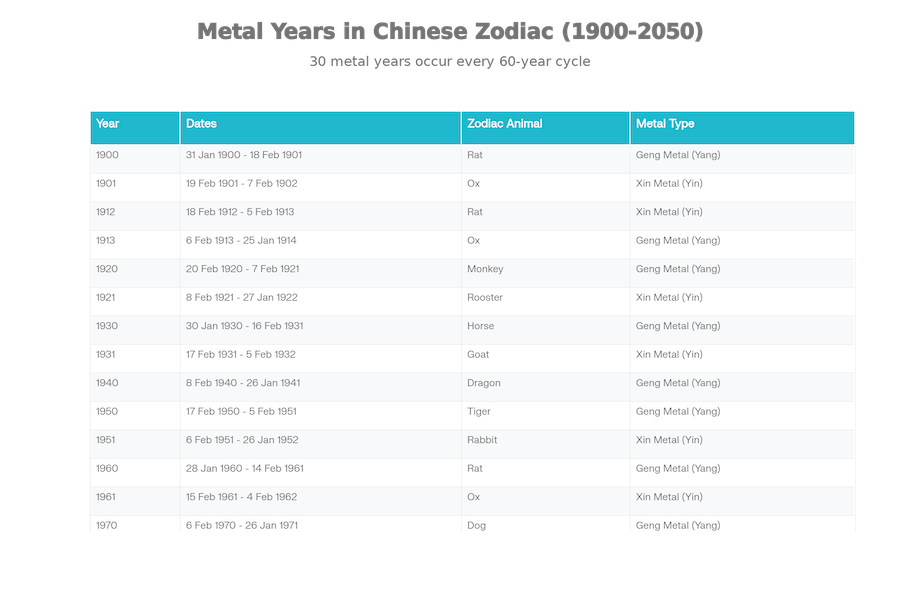
All Metal Element Years in Chinese Zodiac from 1900 to 2050
Metal Years in Chinese Zodiac: A Complete List (1900–2050)
The Metal element appears in the Chinese zodiac in a predictable ten-year cycle, manifesting always in years ending in 0 (Yang Metal/Geng) and 1 (Yin Metal/Xin).
Yang Metal (Geng) Years:
1900 Rat, 1910 Dog, 1920 Monkey, 1930 Horse, 1940 Dragon, 1950 Tiger, 1960 Rat, 1970 Dog, 1980 Monkey, 1990 Horse, 2000 Dragon, 2010 Tiger, 2020 Rat, 2030 Dog, 2040 Monkey, 2050 Horse
Yin Metal (Xin) Years:
1901 Ox, 1911 Pig, 1921 Rooster, 1931 Goat, 1941 Snake, 1951 Rabbit, 1961 Ox, 1971 Pig, 1981 Rooster, 1991 Goat, 2001 Snake, 2011 Rabbit, 2021 Ox, 2031 Pig, 2041 Rooster
Each Metal year carries the distinctive qualities of its paired zodiac animal, creating a unique energetic signature. Those born in Metal years are naturally aligned with qualities of precision, clarity, structure, and refinement. Whether Yang Metal (more direct, forceful, and commanding) or Yin Metal (more refined, diplomatic, and aesthetically sensitive), Metal individuals tend to be organised, principled, and excel at creating order and completing projects with excellence.
Practical Feng Shui Applications
When we translate these concepts into your living space, we are looking at the West and Northwest sectors of the Bagua map.
The Sectors
-
West (Dui Trigram): Represents Children, Creativity, and Future Projects. This is the “Youngest Daughter” energy. It is associated with communication, joy, and creative expression. When this sector is well-supported and clear, you experience enhanced creativity and the completion of projects with grace.
-
Northwest (Qian Trigram): Represents the Patriarch, Helpful People, and Travel. This is the “Father” energy, the ultimate Yang Metal. It is crucial for career advancement, leadership presence, and the ability to attract support and mentorship. A strong Northwest corner creates a foundation for authority and influence in your life.
Materiality and Form
To invoke Metal, you must move beyond colour. Whilst white, grey, and metallics are the associated colours, the material holds the deeper Qi signature.
-
True Metal: Copper, brass, bronze, silver, gold, and iron. A heavy brass bowl creates a stronger field of Metal Qi than a white plastic object. The weight and resonance of actual metal carry energetic presence.
-
Shape: The circle and the arch are Metal shapes. They represent completion and the cycle of heaven. A round table promotes equality and harmonious flow, distinct from the hierarchical rectangular (Wood/Earth) table.
-
Sound: Metal resonates and carries sound with clarity. The sound of a piano, a ticking clock, or a high-quality wind chime cuts through stagnant Qi and activates a space. This is why a 6-rod metal wind chime is a classic enhancement; the number 6 represents Heaven (Qian Metal), and the sound actively shifts and clarifies the energy field.
The Flying Stars: Strategic Enhancement
In Flying Star feng shui, Metal is the harmoniser for Earth sectors that need energetic balance. The two most significant stars to address are Star #2 and Star #5 (Five Yellow). Both are Earth elements.
According to the Five Elements productive cycle, Earth produces Metal. When you introduce Metal to an Earth sector, the Earth energy is beneficially transmuted into the Metal that supports it. This creates a natural flow rather than an aggressive intervention.
Strategic Placement for Period 9
Period 9 (2024 to 2044), is ruled by Fire. This is a transformative era.
-
Star #2: In Period 9, the #2 Black Star is gradually becoming more auspicious as the period matures. However, it remains associated with challenges for certain household members. A strand of 6 metal coins placed in this sector provides energetic support and protection, keeping the space clear and balanced.
-
Star #5: This remains the most volatile star requiring attention. A substantial metal object (like a brass sculpture or a heavy decorative metal piece) placed in the annual #5 sector creates a stabilising anchor. Since Fire enhances Earth, introduce Metal strategically to prevent stagnation. Avoid excessive Fire element displays (red, bright lights) in the #5 sector.
The Period 9 Advantage: Metal in a Fire Age
We have entered a twenty-year cycle dominated by Fire (Li Trigram). Fire and Metal have a dynamic relationship; Fire can refine Metal into its most beautiful and functional forms.
In this Fire period, the world becomes increasingly virtual, fast-paced, and attention-driven (classic Fire traits). Within this environment, Metal becomes exceptionally valuable. Metal provides the structure, clarity, and precision that Fire needs to be constructive rather than scattering.
Think of a steam engine: the fire provides the power, but the metal engine contains and directs it with perfect efficiency. Without Metal, Fire is merely flame. In Period 9, feng shui that emphasises Metal principles (organisation, clarity, financial discipline, strategic boundaries) becomes essential for thriving.
Q&A: Mastering the Metal Element
Q: Can I have too much Metal in my home?
A: Yes, and it manifests as a sterile, clinical atmosphere. A home that is exclusively white, grey, and minimalist with exclusively sharp lines can feel distant and overly austere. Occupants may experience a sense of coldness or excessive mental stimulation. The remedy is to balance Metal with Earth (warm ceramics, beige and terracotta tones) or Water (blue, flowing organic shapes) to create softness and comfort alongside clarity.
Q: Is Metal appropriate for the bedroom?
A: Metal in large quantities is less suitable for bedrooms, as the bedroom requires Yin, receptive energy for rest and intimacy. Excessive Metal (particularly Yang Metal) promotes alertness and activity. A metal bed frame is NOT acceptable (metal can amplify electrosmog) – reserve the bedroom for softer elements. Avoid large mirrored wardrobes or aggressive metallic art installations, as they can overstimulate the space energetically.
Q: I have heard Metal brings wealth. Is this true?
A: Indirectly and strategically. In elemental cycles, Metal produces Water in the productive sequence. Water is the element of wealth circulation and flow. Therefore, Metal is the source of wealth generation. It represents the planning, discipline, strategy, and careful savings that allow wealth (Water) to accumulate and flourish. Without Metal’s organising principle, resources scatter. Metal creates the container and framework within which prosperity can be managed wisely.
Q: My kitchen is in the Northwest (Metal sector). Is this challenging?
A: This configuration is known as “Fire at Heaven’s Gate”, as kitchens are Fire element spaces. The key is not to view this as problematic but to manage the interaction thoughtfully. Introduce Earth element enhancements (ceramics, terracotta, warm earth tones) to act as a bridge. Fire produces Earth, and Earth produces Metal, creating a harmonious elemental flow. This arrangement can actually support career advancement if managed with intention.
Q: How do I know if I would benefit from more Metal?
A: Assess your life patterns. Do you find it difficult to maintain clear boundaries? Is your home or workspace cluttered with unfinished projects? Do you experience mental fog or difficulty with decision-making? Do you struggle to complete cycles or commitments? These are indicators that Metal enhancement would support you. Begin with conscious decluttering (a direct expression of Metal energy) and introduce round, metallic objects to your workspace to sharpen focus and clarity.
Q: What is the difference between Metal applications in Period 8 versus Period 9?
A: In Period 8 (2004 to 2024), governed by Earth, Metal cures were naturally harmonious because Earth produces Metal in the elemental cycle. In Period 9, governed by Fire, Metal takes on a different strategic role. Fire can consume Metal, so Metal becomes a moderating and clarifying force rather than a naturally supported element. In Period 9, Metal is best positioned for protection and clarity rather than for general prosperity generation. Place Metal enhancements strategically in key life sectors (Northwest for career clarity, West for creative completion) rather than dispersing them throughout the entire home.
Q: Can I use stainless steel instead of gold or brass?
A: Absolutely, with understanding. Stainless steel represents Xin Metal (refined, modern, precise) more than Geng Metal (raw, powerful, grounded). It works effectively, especially in contemporary interiors. However, solid brass, copper, or gold carry more energetic presence. If budget is a consideration, a single high-quality brass object positioned with intention and clarity will provide more benefit than numerous lightweight metallic items scattered without purpose.
Q: My bedroom door opens directly to the bathroom. Can Metal help address this?
A: Yes. A metal barrier (a beaded curtain in a metal frame, a metal-framed mirror, or a decorative metal object hung above the bathroom door) acts as an energetic boundary. The Metal creates a psychological and energetic distinction between the two spaces, signalling the separation of function. For maximum effectiveness, the barrier should be functional (opening and closing as needed) rather than purely decorative, as the action of opening and closing reinforces the intentional boundary.
Q: Should I use Metal enhancements if my personal Bazi chart indicates Metal is unfavourable for me?
A: This is where clarity matters. Your Bazi chart reveals your personal elemental constitution and what supports your individual flourishing. However, feng shui operates at the spatial level. A home with a compromised Northwest corner suffers from architectural Metal deficiency, regardless of individual charts. The solution is to use Metal enhancements strategically in afflicted architectural areas (Northwest, West, or sectors with challenging Flying Star numbers) whilst being mindful of your personal space. Alternatively, employ softer Metal expressions (delicate silver objects, lightweight aluminium, gentle grey tones) rather than aggressive Geng Metal (heavy brass sculptures, dark iron pieces).
Q: Is a wind chime with 6 rods really that effective?
A: The six-rod metal wind chime is often misunderstood. Its effectiveness depends entirely on placement and use. If positioned in an area naturally prone to energetic stagnation (a corner, beneath a beam, or in a particularly Yin space), and if it moves frequently due to natural air currents, then yes, the sound and movement actively shift and clarify the energy field. The number 6 represents Heaven and Metal, amplifying its function. However, a wind chime that hangs motionless in a still room or an artificial electronic version functions primarily as decoration. The sound and movement are where the real benefit resides. A wind chime positioned thoughtfully will keep energy flowing and clear.
Q: Can I incorporate Water features in a Metal sector?
A: Yes, with considered placement. In the productive elemental cycle, Metal produces Water, so a modest water feature in the Northwest or West sector can be highly auspicious. Water is cooling and fluid, which can complement Metal’s need for clarity and definition. A metal-rimmed vessel with still water (a decorative bowl rather than a flowing fountain) harmonises both elements beautifully. If you do place water in a Metal sector, keep it contained, still, and contained with intention. Still water in Metal sectors preserves the concentrated clarity you are cultivating.
Q: My office is located in the West (Metal sector). How should I arrange it for optimal function?
A: The West represents future projects, completion of cycles, and creative realisation. For an office, this is an excellent location for project management, strategic planning, and the completion of professional objectives. Arrange your workspace according to Metal principles: clean lines, organised systems, minimal visual clutter, and a round or curved desk if possible to promote flow. Use white, grey, or metallic accents mindfully, allowing natural wood tones to soften and warm the space. Maintain excellent lighting for clarity without harshness; Metal thrives with illumination. Anchor the sector with a substantial metal object (a decorative brass bowl, a sculptural piece, or even a brass-framed artwork) to ground and strengthen Metal Qi. This creates a workspace that naturally supports focus, completion, and professional advancement.
Q: How does Metal element support different life goals?
A: Metal energy supports distinct life objectives through its core qualities. For career advancement, Metal in the Northwest sector sharpens decision-making and attracts mentorship. For creative projects, Metal in the West ensures the completion and refinement of your work. For financial clarity, Metal’s organising principle helps you structure savings and investments wisely. For emotional balance, Metal’s capacity for release supports you in processing experiences and moving forward. For communication, Metal’s resonance and clarity support the articulation of your ideas. Metal is the element of manifestation through refinement; it transforms potential into finished form.
Final Reflections
The Metal element is not fashionable in the way that Water or Fire can be. It does not promise instant wealth or passionate drama. What it offers is far more foundational: the capacity to discern, to decide with clarity, and to distil what truly matters from what merely distracts. In an age of information abundance and Period 9’s Fire-driven transformation, these are genuine superpowers.
Your relationship with Metal begins not with purchasing objects but with examining your own patterns. Can you release what no longer serves? Can you maintain clear boundaries with grace? Can you articulate your values and stand by them? These are the inner Metal qualities that will determine whether any exterior enhancement succeeds. Strengthen your internal Metal first, and your home’s Metal sector will naturally reflect and amplify that transformation, creating a life of greater clarity, purpose, and quiet power.
Important Note on the Five Elements Framework
The Five Elements (Wu Xing) represent a sophisticated system of Chinese philosophical thought that dates back thousands of years. It is essential to understand that this framework is fundamentally metaphoric and observational rather than literal or scientific in the modern sense.
Each element — Wood, Fire, Earth, Metal, and Water — corresponds to observable patterns in nature, seasonal cycles, physiological processes, and human characteristics. Metal, for instance, represents the qualities of autumn: contraction, refinement, clarity, and the natural process of letting go. These are powerful conceptual tools for understanding cycles and imbalances, but they should not be mistaken for direct, mechanical causation.
Critical Distinction: Whilst feng shui offers valuable insights into spatial harmony, environmental psychology, and intentional living, it is not a substitute for professional advice in matters of health, finance, career, or relationships. If you are experiencing significant challenges in any important area of your life, consulting qualified professionals (medical practitioners, financial advisors, therapists, career counsellors) is essential.
Feng shui works best when applied with flexibility, discernment, and humility. Different practitioners interpret the Five Elements in different ways, and what works in one context may not translate directly to another. The framework is a tool for reflection and refinement, not a dogmatic rule set.
When applying Metal element principles to your home or life, view them as invitations to observe your own patterns rather than prescriptive solutions. Do you naturally resist releasing old patterns? Does your environment support mental clarity? Are your boundaries well-defined? These are the kinds of reflective questions that feng shui genuinely illuminates.
Always consult a qualified feng shui practitioner for significant life decisions or if you wish to apply these principles to important areas of your home or circumstances. The insights offered in this blog are educational and exploratory; they are not diagnostic or prescriptive recommendations.
Summary of the Jung, Deleuze and Alchemy: the Metallurgist
The Essence of Metal: Not a Thing, But a Process
The Descent: Metal Moving into Water (Liquefaction)
The Return: The Regulus and Crystallisation
The Feng Shui Practitioner as “The Metallurgist”
Summary: The alchemy of metal is the art of timing the transition between solid (structure) and liquid (flow). By understanding metal not just as a material but as “continuous variation,” we can use it in feng shui to ensure that the “King” (the life force of the home) does not stagnate, but constantly renews itself through the purifying waters of the unconscious.