
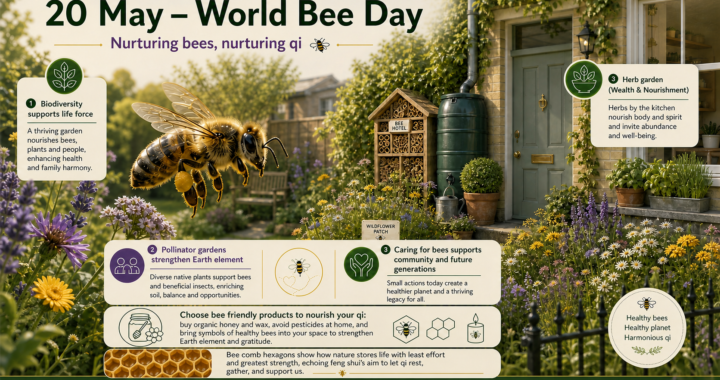
How tiny pollinators, local honey and natural geometry can nourish our homes, bodies and the wider field of life
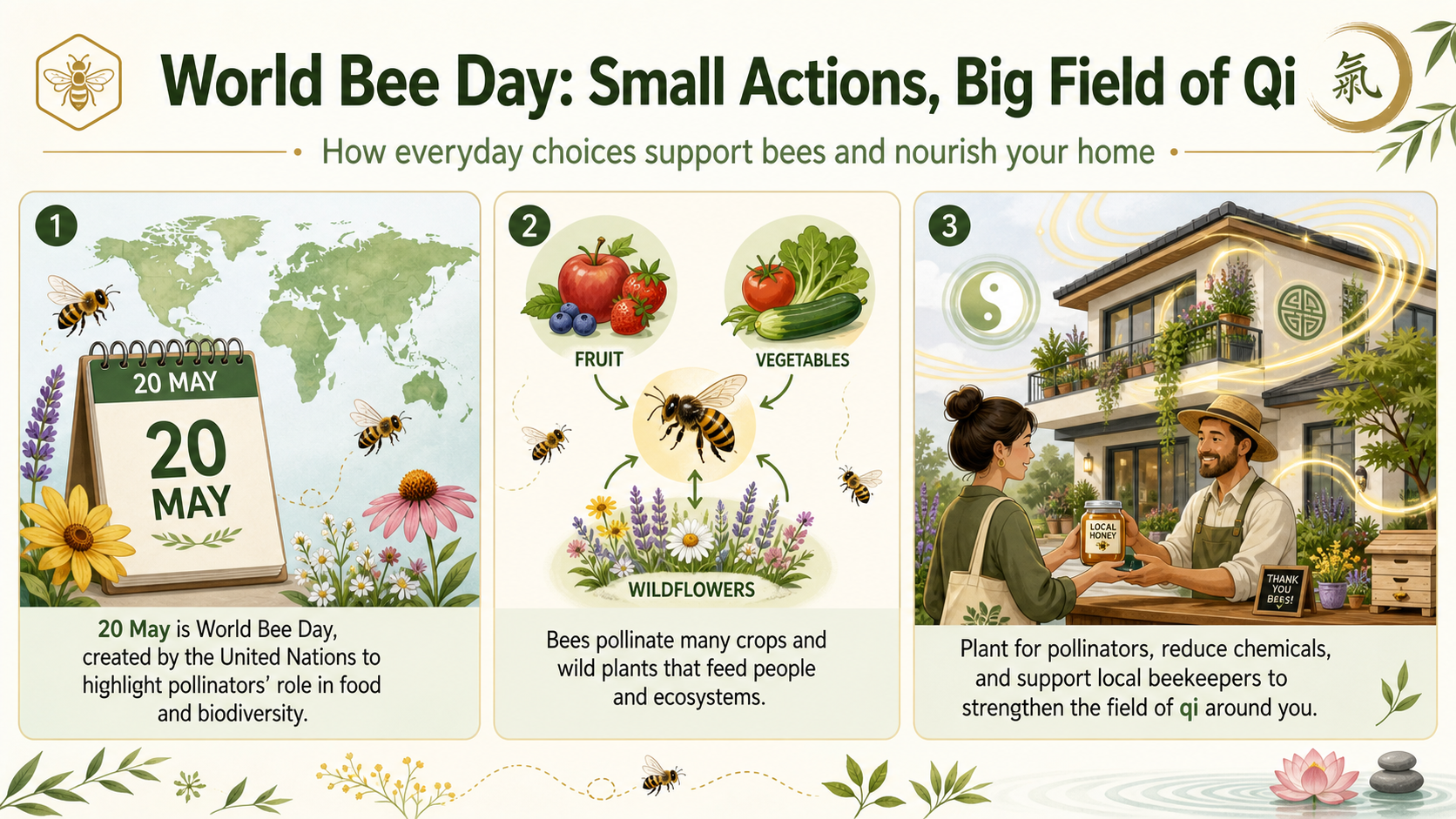
20 May is World Bee Day, a reminder that the tiny bodies of bees hold up a remarkable amount of our food system, our landscapes and, arguably, our collective wellbeing. The day was created to honour both the ecological importance of pollinators and the long relationship between humans and bees. For anyone interested in feng shui, environmental psychology or simply living well in place, bees offer a rich, tangible way to think about qi, reciprocity and design.
World Bee Day and why it matters
World Bee Day highlights the fact that bees and other pollinators are under pressure from habitat loss, pesticides, climate change and disease. Without them, many fruit, vegetable, nut and seed crops would suffer serious declines, and wild plant communities would lose an essential source of pollination. The day is also about empowerment: we do not have to be beekeepers to help bees. Small actions such as planting bee-friendly flowers, buying local honey, supporting organic farming and reducing chemical use all contribute to the larger web of support.
From a feng shui perspective, this is a reminder that qi is not confined to the inside of a house. The quality of energy in our homes is inseparable from the health of the wider landscape that feeds us. When we improve conditions for bees in our neighbourhood, we are indirectly tending the qi that eventually arrives on our plates and in our lungs.
Bees: small bodies, huge impact
Bees have multiple specialised eyes that help them detect movement, light and flowers. They possess two stomachs, one for their own nourishment and one for carrying nectar back to the hive, where it will be transformed into honey. Their sense of smell is highly developed, allowing them to distinguish fine differences between floral scents and to navigate complex environments. Bees can carry pollen loads nearly as heavy as their own bodies, which is an extraordinary undertaking when repeated hundreds of times across a day.
Bees are also social and communicative. They make buzzing sounds with their wings, and they perform the famous “waggle dance” to tell nest mates where rich food sources can be found. A hive responds collectively when the queen is missing, showing that this is a deeply interdependent community rather than a simple collection of individuals. Bees can learn, remember and work together in ways that are increasingly recognised as forms of insect intelligence.
In environmental psychology and feng shui, we often ask how environments support collaboration, memory and mutual care. A thriving hive is a natural example of a place whose form and rhythms are closely aligned with its purpose. It is a living model of interdependence.
Senses, intelligence and the “map in the bee mind”
Modern research suggests that bees do more than follow fixed routes. They appear to hold a form of internal spatial map. When scientists displace forager bees to unfamiliar locations, many of them can still find their way back to the hive, adjusting their flight paths using landmarks and the position of the sun. This implies that bees construct a map like memory of their territory, which they combine with sun compass information and social cues from the waggle dance.
It is tempting to imagine that this internal map somehow transfers into the honey. Biologically, there is no evidence that cognitive content is stored in honey in this way. Honey is created when bees transform plant nectar with enzymes and evaporate water, concentrating sugars and trace compounds. What we can say is that honey condenses the chemistry of a landscape. It is made from the nectars of many plants across the bees’ foraging range, gathered and reworked by bodies that know that territory intimately.
For a feng shui informed reader, this offers a powerful metaphor. Local honey can be seen as a sweet, edible expression of the surrounding field of qi. The bees have flown the territory, reading light, scent and landmarks, and have returned with a distillation of that experience. When we eat local honey slowly and consciously, we participate in that exchange.
The hexagon: nature’s efficient pattern
One of the most striking visual features of bee life is the honeycomb, with its repeating hexagonal cells. This pattern has fascinated mathematicians, physicists and artists for centuries. Hexagons tile a surface without gaps and use the least building material to enclose the greatest volume compared with other regular shapes that can tile a plane. This means bees can store large quantities of honey and brood while using a minimum of precious wax.
Studies of comb building suggest that bees may start with slightly rounded or irregular cells that then refine into hexagons under the influence of heat, surface tension and small movements. Physics and biology collaborate to produce a pattern that is both strong and economical. Hexagons also appear in many other natural contexts, including basalt formations and some bubble patterns, which reinforces the sense that the hexagon is a favoured solution when systems seek stable, efficient packing.
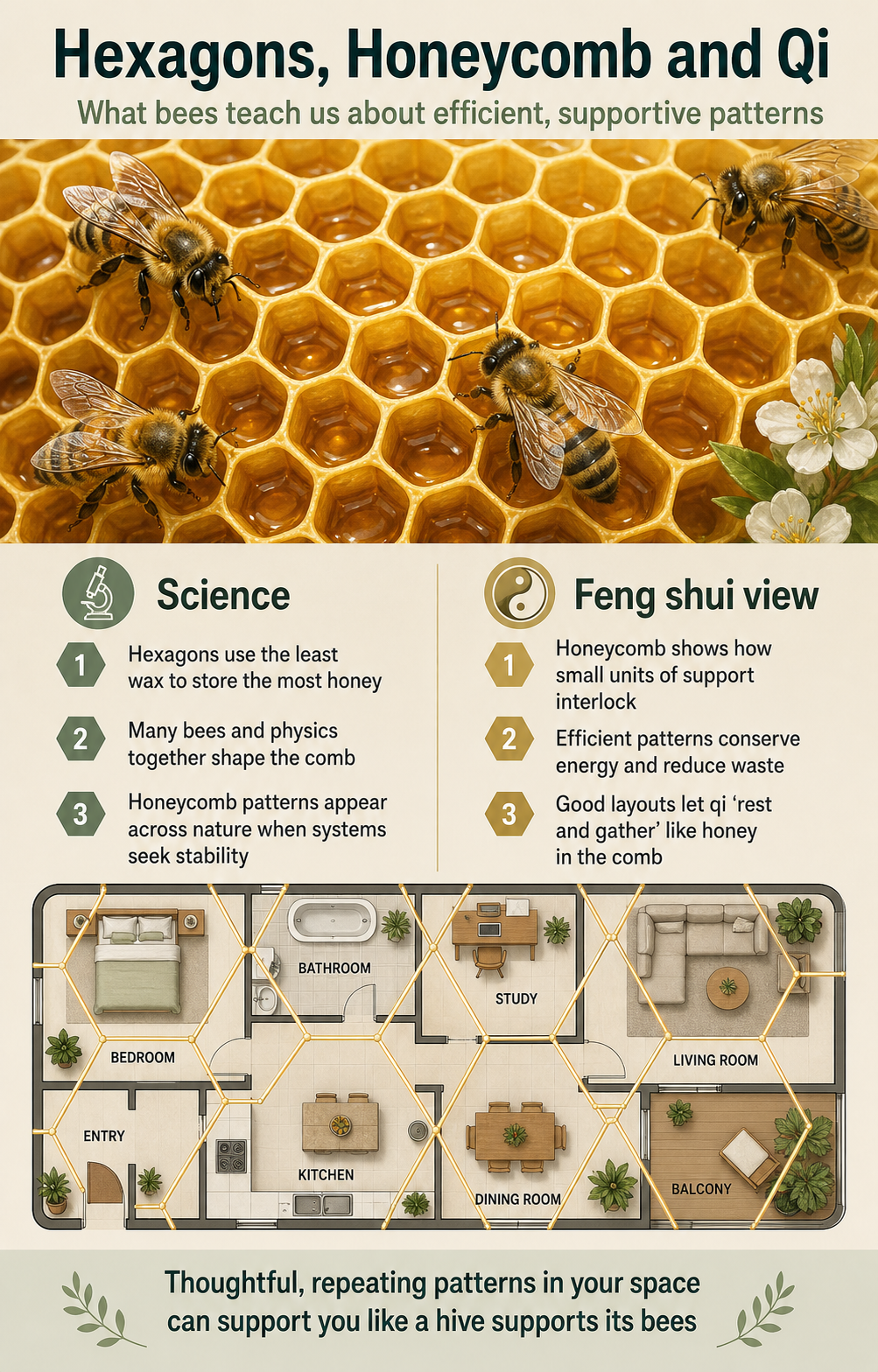
For feng shui, the honeycomb is a beautiful analogue for how supportive environments work. Each cell is small and modest, yet the interlocking pattern allows the whole structure to be resilient. Similarly, in a home or workplace no single object or adjustment needs to carry the entire burden of change. Many small, thoughtful choices about light, order, orientation, colour and sound can lock together like comb cells, creating a field that holds and distributes qi with minimal waste.
Hexagons as a meeting point of number, nature and spirit
In several ancient traditions, hexagonal and six pointed patterns sit at the boundary between mathematical insight, observation of nature and cosmological meaning. In the Greek world, early Pythagoreans treated number as the fabric of reality, and they were particularly fascinated by figures that could tile a plane without gaps. The hexagon, together with the triangle and square, belonged to this privileged group of “fitting” shapes, suggesting a world in which order arises from the seamless joining of parts.
In the Middle East and North Africa, Islamic geometers developed complex star and honeycomb like tessellations for mosques and madrasas, not as mere decoration but as visual dhikr, a remembrance of unity expressed through multiplicity. Six pointed rosettes, hexagon based grids and interlocking stars were understood to hint at an underlying, intelligible structure in creation that extends indefinitely in all directions. These patterns were constructed with compasses and straightedges, so the hexagon emerged directly from the circle, reinforcing a view of the cosmos where the One (the circle) unfolds into the Many (the hexagonal lattice).
In the Jewish mystical tradition, the six pointed Star of David, while historically layered and not originally universal, came to be read by some commentators as a symbol of harmonised polarities: up and down, inner and outer, heaven and earth. Although the star itself is made of overlapping triangles, its internal geometry is hexagonal. The six outer points surrounding a central space offer a visual model of a field held in balance from all directions, a concept that resonates with how honeycomb distributes load and stores sweetness.
In classical Chinese thought, hexagonal forms were not singled out in the same explicit way, yet the interplay of six directions (north, south, east, west, up, down) and centre recurs in cosmological schemata. Later readers who noticed natural hexagons in snowflakes, crystals or wax comb could easily map them onto this six plus one pattern: six orientations stabilising a centre where qi condenses. From a contemporary feng shui perspective, this allows honeycomb to be read as a quiet emblem of “held space”: a central store of nourishment kept stable by an all round field of support.
Taken together, these strands suggest that when ancient thinkers encountered hexagonal or hexagon based patterns, they frequently saw more than a convenient shape. They recognised a visual grammar in which unity emerges from repeating, interlocking parts; where strength is distributed rather than centralised; and where the sweetness or meaning held at the centre depends on the integrity of the surrounding field. That is precisely what bees achieve in their comb and what good spatial design or feng shui aims to achieve in a home.
Local honey, place and wellbeing
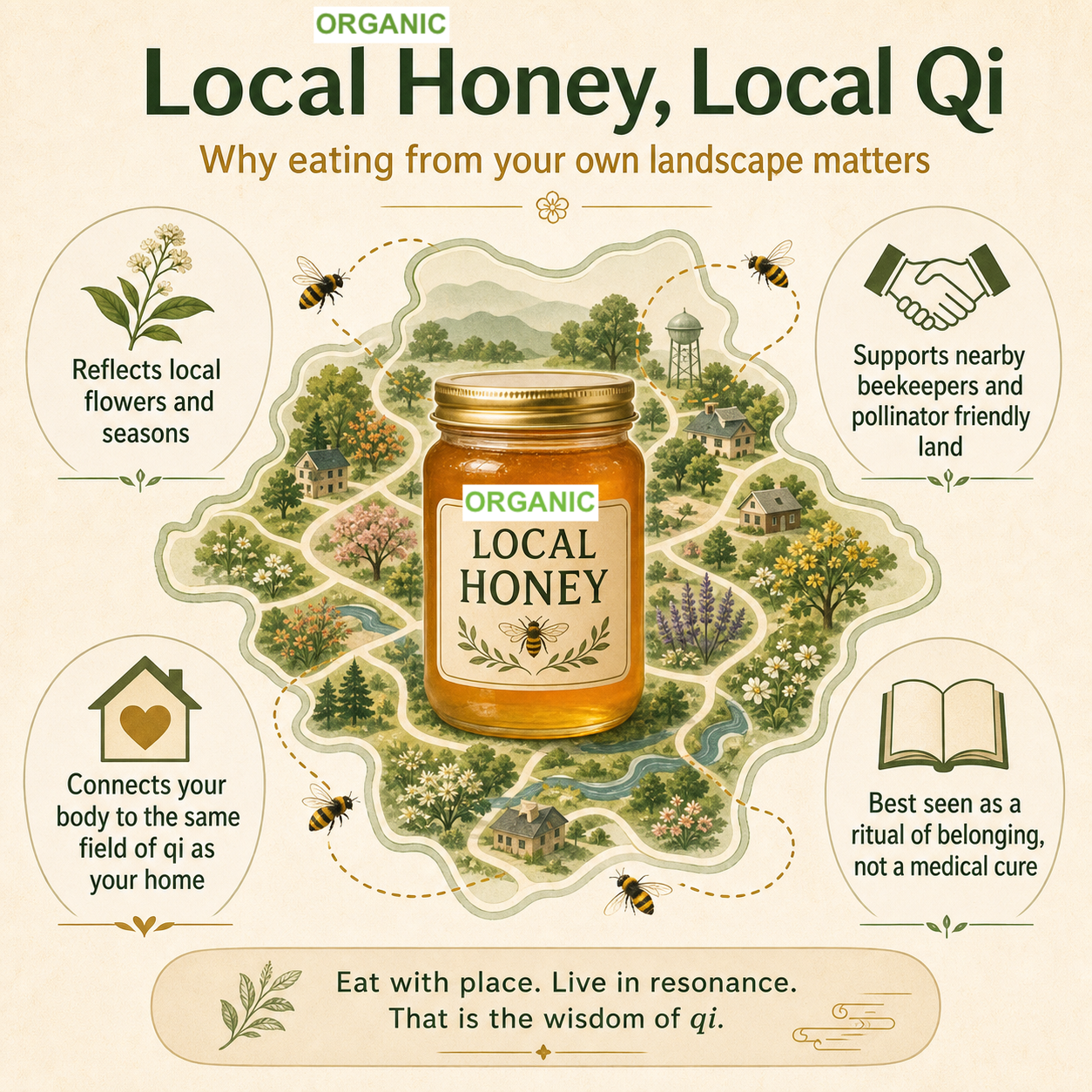
Honey is more than a generic sweetener. Its composition varies with the plants bees visit, which means that each region and season produces its own flavour, colour and chemistry. Some honeys, such as manuka, heather or thyme, are known for distinctive antimicrobial or antioxidant properties related to their floral sources. Even everyday multifloral honeys carry trace elements and plant compounds that reflect local conditions.
There is popular interest in the idea that eating local honey might help some people with seasonal allergies by providing tiny exposures to local pollens. Scientific evidence is mixed and it should not be treated as a medical treatment in itself, especially for people with severe allergies. What is clear, however, is that buying and consuming local honey can support nearby beekeepers, encourage pollinator-friendly landscapes and shorten supply chains.
From a feng shui viewpoint, local honey resonates with the principle of aligning our bodies and homes with the qi of the actual place we inhabit. Ingesting the sweetness that arises from the same air, water and soil that surround our dwelling can be viewed as a gentle ritual of belonging. It is a way of saying yes to a relationship with local plants, insects and people rather than living entirely off distant, abstract supply networks.
Bees, feng shui and the flow of qi
Bees and feng shui share several themes: attention to place, sensitivity to flows and boundaries, and a focus on the quality rather than the sheer quantity of activity.
Bees as indicators of healthy qi
In traditional feng shui, observations of wildlife and vegetation were key diagnostic tools. Lush growth, birdsong and clear water often signalled auspicious qi. Today, bees offer an additional, scientifically grounded indicator. They need continuous access to flowers, clean water and relatively low levels of toxic chemicals. Their presence usually points to an environment where biodiversity, seasonal rhythm and some degree of ecological continuity are present.
When a garden, courtyard or neighbourhood is alive with bees and other pollinators, it suggests that the life force is circulating rather than being blocked by concrete, monoculture or heavy chemical use. This is entirely in line with feng shui principles that favour flowing, vibrant environments over stagnant or barren ones.
Hives as models of cooperative design
The hive is a structure where form and function are tightly integrated. Temperature, ventilation, storage and communication all depend on how the hive is built and organised. The hexagonal comb allows efficient storage and structural strength, the entrance is positioned for orientation and defence, and internal pathways support movement and signalling.
In human terms, this encourages us to think of homes and workplaces not only as collections of rooms but as living systems. Where is the entrance and how does it feel to cross the threshold? Do the main pathways allow smooth, unforced movement? Are there clear centres where people gather and quieter cells where they can rest? Just as bees maintain hive cleanliness to protect health, regular, mindful care of our own spaces keeps qi fresh and reduces the subtle stress that accumulates around clutter and neglect.
Navigation, orientation and feeling at home
Bees build internal maps that allow them to travel confidently across their territory and then return home. Humans also rely on internal maps, both spatial and emotional. Confusing layouts, blocked sightlines and disorienting lighting can subtly undermine our sense of safety and competence. Feng shui seeks to create spaces where orientation is intuitive: the front door is easy to find and welcoming, key areas are legible, and movement between them feels coherent.
In this light, the bees’ waggle dance is an evocative metaphor. It is a movement practice that encodes knowledge about the environment. Our own movements through a building, from entrance to kitchen to desk to bed, also encode meaning. If these paths are repeatedly awkward or obstructed, they tell a story of strain. If they are smooth and supported, they reinforce a sense of being “in tune” with our habitat.
Practical ways to honour bees and nourish qi
To translate these ideas into daily life, the following practical steps support bees and align with a feng shui-informed ethic of care.
Everyday choices
-
Buy local organic honey and bee products when you can, ideally from small producers who prioritise bee welfare and diverse forage.
-
Reduce or avoid pesticides and herbicides in your home, balcony and any shared outdoor spaces. Even small reductions lessen the toxic burden on bees.
-
Plant for pollinators, even in tiny spaces. Window boxes, balcony pots and small courtyard beds can host nectar-rich plants that offer food and orientation points.
-
Provide water in a shallow dish with stones or pebbles so bees can drink safely.
-
Support organisations and policies that protect pollinators, such as urban wildflower corridors, reduced roadside mowing and community gardens.
Feng shui-informed adjustments
-
Bring images or small objects featuring healthy bees or honeycomb into your home as reminders of cooperation, sweetness and the power of many small efforts.
-
Keep kitchens and eating areas clean and well ventilated, reflecting bees’ own strong hive hygiene.
-
Design workspaces with both focus and rest zones, acknowledging that, like bees, we are not made for constant, unbroken labour.
-
Notice where your daily movement feels constrained at home. Where possible, clear pathways and adjust furniture to create smoother, more legible routes, just as bees depend on clear flight paths.
Q & A
Does eating local honey give me the bees’ map of the area?
No. The map exists in the bees’ nervous systems and behaviour, not in the honey itself. Honey can be seen as a condensed expression of the local landscape because it is made from many plants in the area, but the cognitive map is not transferred. Local honey remains valuable as a symbolic connection to place and a way to support pollinator-friendly agriculture.
Is the hexagon a special spiritual symbol, or just efficient geometry?
In honeycomb, the hexagon is primarily a solution to a physical problem: how to store the most honey with the least wax while maintaining strength. Many cultures later attached symbolic meanings to hexagons, seeing them as signs of harmony and balance. In practice, its power lies in showing how function and beauty can coincide, which aligns well with feng shui ideals.
Is having a beehive near my home good or bad feng shui?
A healthy hive nearby can benefit local ecosystems and symbolise lively, cooperative qi. However, practical issues such as allergies, safety and neighbour comfort are crucial. From a feng shui standpoint, genuine harmony includes good relationships with human neighbours and non-human ones, so any hive placement should be carefully considered and managed.
What if I am afraid of bees?
Fear is understandable. Feng shui does not require close contact with bees. You can support them indirectly through planting, purchasing choices and advocacy. Gentle education and observing bees at a safe distance can gradually shift perception from threat to relationship, but this should be done at your own pace.
You can celebrate World Bee Day in very simple, practical ways. Here are ideas you could use in a Q&A section.
Q: What are simple ideas to celebrate World Bee Day (20 May)?
You do not need a garden or a hive to honour bees. Here are accessible options for most people:
-
Plant one bee-friendly pot
Choose a small pot or window box and plant nectar-rich flowers such as lavender, thyme, marjoram, chives, heather or native wildflowers. Aim for something that will provide colour and bloom later into the season, extending food for pollinators. -
Buy local (organic) honey and thank your bees
If you can, buy a jar of genuinely local, organic honey from a nearby beekeeper or farmers’ market. Use it mindfully on that day: notice the flavour, colour and aroma, and acknowledge that it condenses the flowering landscape around you. -
Go pesticide-free at home
Commit to avoiding insecticides and herbicides in your pots, balcony, allotment or garden. Even deciding “no spraying” on your patio or houseplants is a real contribution to safer foraging routes for bees. -
Create a bee watering station
Put out a shallow dish of water with clean pebbles or marbles so bees can land and drink without drowning. Place it somewhere shaded and refill regularly. -
Add a bee symbol to your space
Place a small image, postcard or object with a bee or honeycomb motif where you will see it daily, such as near your desk or in the kitchen. Treat it as a reminder of cooperation, shared labour and the sweetness that comes from healthy environments. -
Share one fact about bees with someone
Tell a friend, child, client or colleague one thing you have learned about bees, such as their waggle dance, their role in pollination, or the efficiency of honeycomb hexagons. Turning knowledge into conversation helps it spread. -
Support a pollinator-friendly project
If finances allow, make a small donation or sign up to volunteer with a local wildlife trust, community garden or pollinator corridor project. If not, amplify their work by sharing their resources on social media.
World Bee Day (20 May) invites us to look more closely at the lives of bees and to see them not only as providers of honey and pollination, but as teachers of pattern, cooperation and attunement to place. Whether through a jar of local honey on the table, a pot of flowers on a balcony, or a subtle honeycomb motif in a room, we can choose to participate in a field of mutual support where bees, humans and landscapes all benefit.
References
Food and Agriculture Organization of the United Nations. (2026). World Bee Day 2026. Retrieved from the FAO World Bee Day website.
Menzel, R., & colleagues. (2005). Honey bees navigate according to a map like spatial memory. Proceedings of the National Academy of Sciences.
Menzel, R., & colleagues. (2014). Way finding in displaced clock shifted bees proves bees use a cognitive map. Proceedings of the National Academy of Sciences.
Science communication resources on honeycomb geometry and hexagonal efficiency in nature (various authors).
General educational materials on bee biology, communication and hive behaviour, including children’s infographics summarising key facts about bees.