

Subtractive Neglect Bias: What feng shui Can Teach Us About the Power of Less
When people want to improve a space, a routine, or a difficult situation, they often ask, “What can I add?” A more useful question may sometimes be, “What can I remove?” This tendency to overlook beneficial removal is known as subtractive neglect bias, and it has important implications for feng shui, environmental psychology, and everyday wellbeing.
Within feng shui, improvement is not necessarily achieved by bringing in more objects, colours, cures, symbols, or decorative features. It may arise through clearing, simplifying, repairing, releasing, and making room for movement, light, rest, and attention. The aim is not minimalism for its own sake, nor the indiscriminate removal of possessions. Rather, it is to consider whether an existing element obstructs the intended functioning, atmosphere, or experience of a place.
Why subtraction is overlooked
Research suggests that people commonly default to additive solutions when trying to change an object, idea, or situation. Across eight experiments, Adams et al. (2021) found that participants were less likely to identify advantageous subtractive solutions unless they were explicitly cued to consider removing something. They concluded that people often begin by searching for additions and may not generate subtractive possibilities at all, particularly when they have little time or are under greater cognitive load (Adams et al., 2021).
This tendency has relevance beyond physical design. It can shape how people respond to busy schedules, administrative processes, writing, relationships with possessions, and domestic environments. If the first question is always “What else do I need?”, people may accumulate objects, tasks, commitments, visual stimuli, and design interventions without considering whether the more effective response is to reduce what is already present.
In feng shui terms, the quality of an environment is often understood in relation to flow, balance, support, legibility, and the relationship between people and place. From an environmental psychology perspective, this can be interpreted cautiously in terms of factors such as environmental load, visual complexity, ease of movement, perceived control, and the ability of a setting to support intended activities. The evidence base does not validate all traditional feng shui claims as scientific fact, but many practical recommendations can be examined as hypotheses about person environment fit, attention, behaviour, and wellbeing.
The Lego study: paying to add, overlooking free subtraction
A particularly clear demonstration of subtractive neglect came from a Lego task conducted by Adams and colleagues. Participants were asked to alter a Lego structure so that it could safely support a heavy masonry brick above a small Lego figure. They could add Lego pieces, but each added piece reduced their monetary reward by 10 cents. Removing a Lego piece was free.
The additive solution involved placing further bricks beneath the platform to stabilise it. However, the more efficient solution was to remove one existing supporting block. This enabled the platform to rest directly and securely on the wider base, while still leaving sufficient room for the Lego figure beneath it.
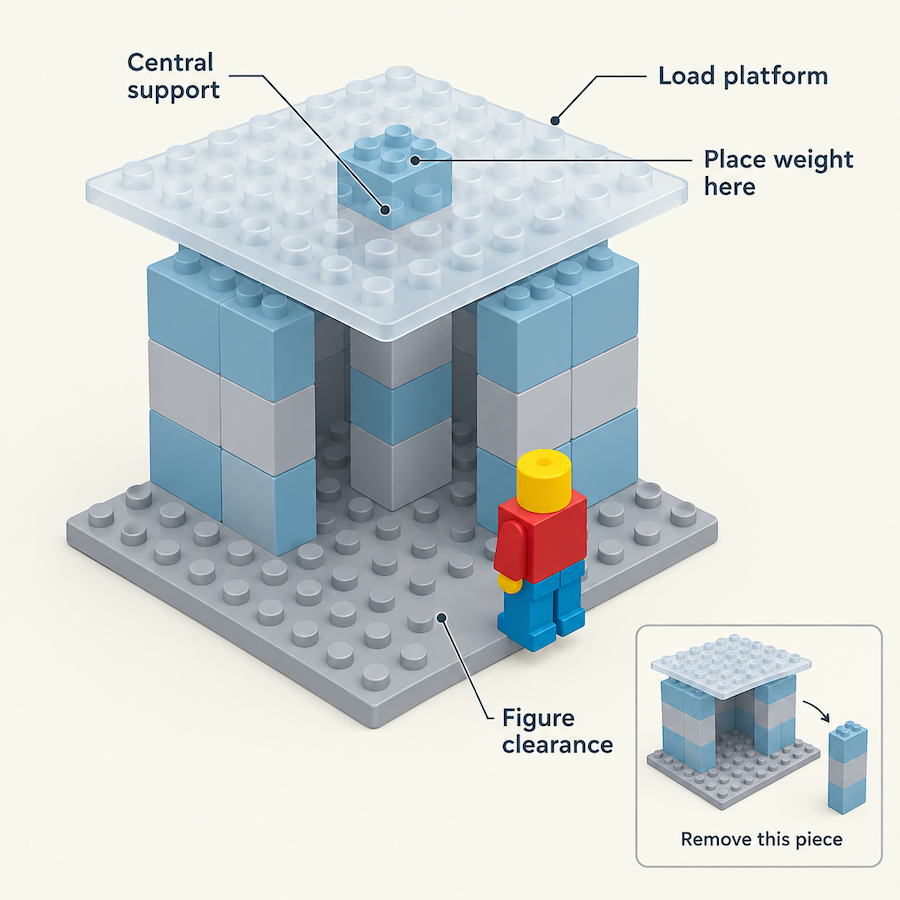
In other words, subtraction was simpler, cheaper, and fully effective. Yet, in the control condition, approximately 59% of participants added Lego pieces rather than removing the single obstructive piece. When participants were explicitly reminded that removal was free, they were more likely to recognise the subtractive solution. The prompt did not change the physical task or provide a new technical solution. Instead, it made subtraction cognitively available as an option (Adams et al., 2021).
The study is especially useful because it challenges the assumption that people fail to subtract only because they lack motivation or incentive. Here, participants had a financial reason to remove rather than add. Nevertheless, many still chose the more costly additive strategy. This suggests that, in practical settings, people may buy more storage, furniture, decorative objects, organisational systems, or symbolic remedies before considering whether one obstructive, redundant, broken, or distracting element could simply be removed.
Feng shui examples of subtraction
1. Clearing clutter rather than buying more storage
A common response to household clutter is to purchase boxes, shelving, drawers, baskets, organisers, or larger furniture. These can be useful where there is a genuine storage need. However, they can also conceal rather than resolve accumulation.
A subtractive approach begins with the question: what no longer needs to be in this space?
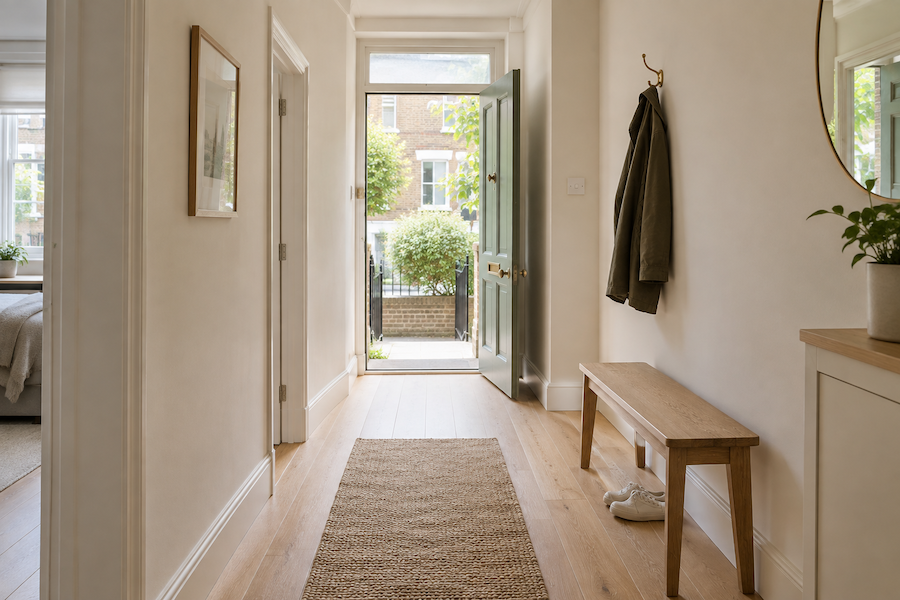
For example, a hallway may feel cramped not because it lacks another storage unit, but because it contains unused shoes, bags, parcels, coats, old post, broken umbrellas, and objects awaiting decisions. Removing items that do not belong there can restore ease of entry and exit, reduce visual demand, and make the circulation route clearer.
In feng shui language, this may be described as supporting the free movement of qi. In environmental psychological terms, it may reduce environmental distraction and make the intended function of the space more legible. The practical principle is not “remove everything”. It is: retain what supports the purpose of the space and release what competes with it.
2. Improving the entrance by removing obstructions
The entrance is often given particular importance in feng shui because it mediates the transition between outside and inside. A common additive response might be to buy a new mirror, brighter light, welcoming artwork, plants, a runner, or decorative symbols.
Before adding anything, examine whether the entrance already has obstructive features:
- A damaged doormat
- A crowded shoe pile
- A chair used as temporary storage
- Bags, recycling, or parcels blocking the route
- A door that cannot open fully
- Poorly maintained or broken fixtures
- Too many visual messages competing for attention
Removing or relocating these may produce a larger functional improvement than adding another object. A clear entrance communicates practical welcome because it enables arrival, departure, and transition without unnecessary friction.

3. Simplifying the bedroom for rest
Bedrooms often become repositories for work materials, laundry, exercise equipment, storage boxes, screens, cables, and unfinished tasks. The additive solution might be to introduce more candles, new bedding, crystals, soothing artwork, an air purifier, or another bedside table.
These additions may be personally meaningful, but they may not address the main issue if the room is visually overloaded or functionally mixed. A subtractive feng shui intervention could involve removing work documents from view, relocating laundry, reducing under bed storage where feasible, taking away redundant furniture, or clearing a chair that has become a clothes pile.
The aim is to strengthen the room’s primary identity as a place for sleep, intimacy, restoration, and privacy. This need not mean creating an austere or impersonal room. It means ensuring that the visual and practical signals in the environment are congruent with the activity one hopes the room will support.
4. Creating a more effective workspace by reducing distractions
When a desk feels unproductive, many people buy new planners, desk organisers, additional screens, stationery, task management tools, lamps, or productivity devices. Yet the problem may be a surplus of cues competing for attention.
A subtractive approach might involve removing:
- Outdated notes and documents
- Unused devices and cables
- Multiple competing to do lists
- Decorative items that reduce usable work surface
- Notifications from unnecessary applications
- Commitments that no longer contribute to the research or professional aim
For a PhD workspace, this may mean keeping only the materials needed for the current writing, analysis, or reading task in immediate view. The intention is not to eliminate meaningful objects or create a generic desk. It is to reduce unnecessary switching costs and make the next action more obvious.
5. Improving a room’s flow by removing surplus furniture
A room may feel stagnant or awkward because its pathways are constrained. The conventional response might be to redecorate, add a feature wall, introduce more lamps, buy smaller storage units, or install additional accessories.
However, removing one oversized chair, redundant side table, unused exercise machine, or bulky decorative item may immediately improve circulation. In feng shui, clear pathways are commonly associated with smoother movement through a space. In practical design terms, they support accessibility, reduce friction, and make a room easier to inhabit.
This is particularly important in smaller homes, where each object has a relatively large effect on movement and perceived spaciousness.
Applying fluxray principles through subtraction
If fluxray principles are understood as principles concerned with flow, direction, clarity, and the relationship between environmental patterns and intended outcomes, subtraction offers a useful practical interpretation. The following ideas simplify this approach without treating it as a rigid formula.
Clarify the intended direction
Before changing a space, identify what it is meant to support. A living room may need to support conversation, recovery, reading, play, or hospitality. A study may need to support concentration and sustained work. A bedroom may need to support sleep and restoration.
Once the intended direction is clear, ask:
What in this environment works against that purpose?
The answer may not be the absence of another object. It may be the presence of something unnecessary, unfinished, obstructive, or symbolically inconsistent with the desired experience.
Let go of inherited assumptions
Subtractive change often requires releasing ideas as well as objects. People may hold assumptions such as:
- More furniture makes a home feel more complete.
- Every empty surface needs decoration.
- An unused item should be kept because it may be useful someday.
- A productive person should always be busy.
- A meaningful home must visibly display every interest, memory, or possession.
- Improvement requires purchasing something new.
These assumptions can create environmental and psychological burden. Letting go of them does not mean rejecting comfort, beauty, heritage, or material enjoyment. It means distinguishing between what genuinely supports one’s aims and what persists by habit, guilt, fear, or social expectation.
Remove barriers before adding motivation
A person may attempt to create change by adding more discipline, more routines, more reminders, more goals, or more self criticism. A subtractive perspective asks whether barriers can be removed first.
For example:
- Rather than adding a complex morning routine, remove decisions by preparing essential items the night before.
- Rather than adding another productivity system, remove duplicate commitments and outdated tasks.
- Rather than adding more storage, remove possessions that no longer have a role.
- Rather than adding more decorative harmony, remove visual noise and obstructed pathways.
- Rather than adding more explanation to academic writing, remove repetition and sentences that do not serve the argument.
This does not imply that all problems can be solved by simplification. Some require resources, care, structural change, professional support, or additional provision. The value of subtractive thinking is that it ensures removal is considered alongside addition.
A practical subtraction audit
Before buying, adding, fixing, or reorganising something in a home or workspace, pause and ask five questions:
- What exactly am I trying to improve?
- What currently obstructs that outcome?
- Could removing, relocating, repairing, or completing something solve the problem?
- What would become easier if this element were no longer present?
- If I add something, does it genuinely improve the situation, or does it create another item to manage?
For example, if a sitting room feels unsettled, do not begin by buying more cushions, plants, or decorative objects. First assess whether there are incomplete repairs, blocked routes, redundant furniture, visual clutter, unused possessions, or conflicting functions within the room. Only then decide whether a carefully chosen addition is genuinely needed.
Questions and answers
Is subtractive thinking simply minimalism?
No. Subtractive thinking is not an instruction to own as little as possible or to create visually empty spaces. It is a problem solving approach: consider whether something can be removed, relocated, repaired, simplified, or completed before assuming that an additional object, task, rule, or intervention is required. A home can be warm, personal, comfortable, and richly meaningful while remaining clear in purpose and movement.
Does feng shui require removing possessions?
No. feng shui does not require indiscriminate clearing or deprivation. The relevant question is whether a possession, arrangement, or feature supports or obstructs the intended use and experience of a space. Sentimental, cultural, practical, and aesthetic value should all be considered. The goal is thoughtful discernment, not purging.
What is the simplest place to start?
Begin with one small transition zone, such as the entrance, a bedside surface, a desk, or the route between a door and a frequently used chair. Remove or relocate items that do not belong there, repair what is broken, and ensure that the pathway is clear. Observe whether the space becomes easier to use before adding anything further.
How does this apply to goals beyond the home?
The same question can be used for work, research, relationships with time, and daily routines: “What could I remove that would make the desired outcome easier?” This might mean withdrawing from an unnecessary commitment, simplifying a workflow, deleting duplicate files, reducing notifications, or removing a step from an administrative process.
Does the Lego study prove that subtraction is always better?
No. The study shows that people may systematically overlook useful subtractive solutions, even when these are cheaper and more effective. It does not establish that subtraction is universally superior. Many circumstances require addition, investment, repair, care, resources, expertise, or structural support. The key point is to consider both possibilities rather than assuming that adding is the only route to improvement.
Conclusion
Subtractive neglect bias reminds us that “more” and “better” are not synonymous. The Lego study shows that people can overlook a free and efficient solution simply because they are primed to add rather than remove. In the context of feng shui, this offers a useful interpretive lens: many environmental difficulties may be improved not through accumulating more objects, remedies, systems, or commitments, but through thoughtful release.
Clutter clearing is one visible example, but the principle extends further. It can involve removing obstructions at the entrance, reducing bedroom distractions, clearing a workspace, simplifying circulation, letting go of unhelpful assumptions, and reducing barriers that interfere with the life one wishes to create. The essential question is not whether less is always better. It is whether what remains more clearly supports the purposes, relationships, activities, and qualities of life that matter.
References
Adams, G. S., Converse, B. A., Hales, A. H., & Klotz, L. E. (2021). People systematically overlook subtractive changes. Nature, 592(7853), 258–261. https://doi.org/10.1038/s41586-021-03380-y
Nisbett, R. E. (2021). Adding is favoured over subtracting in problem solving. Nature, 592, 224–225. https://doi.org/10.1038/d41586-021-00592-0. This commentary describes the Lego task: additions cost 10 cents per block, whereas removing the original supporting pillar allowed the roof to rest on the base.